Showing posts with label narrative. Show all posts

Sunday, June 10, 2018

Composition: Harmony and Variety

In paintings or photos, balance creates attention and beauty. No single element should overwhelm any other, while those individual components echo, contrast, and complement. Finally, monotony of form, color, or anything else, muddies. Where’s the focal point?


These precepts also pertain to the novel, though, obviously, not in terms of color or shape. The fundamentals of fiction include:

* Action: Dramatization of cinematic scenes.

* Dialogue: Two or more characters conversing.

* Narrative: Transition and context grounding action and dialogue.

* Information: Backstory, exposition, facts, or intellectual stimulation.

Tip: Good fiction varies and harmoniously balances its components.

~ No one element should overwhelm the other
Unless sufficient narrative supports the action, you’ve dumped the reader in the stream without a life preserver.      Everything in fiction serves story. So even if this is an informative moment, it mustn’t overwhelm the characters’ journey. Still, too much action resembles a few crumbs of cake slathered with a quarter-can of frosting. In fiction and everything else, too much of a good thing remains—too much.
~ Individual components echo, contrast, and complement.
Fiction immerses readers when the whole’s more than the sum of its parts. The narrative adds irony or clarity to the dialogue. If the stage business simply repeats, such as “‘Get Out!’ Marge shrieked angrily,” you’ve neither contrasted nor complemented.     But, for example, if setting affects the action, or intensifies the dialogue, one element enhances another.      Contrast matters, too. When suspense is high, tease readers with an information break. Conversely, if you’ve just explained at length, appeal with humor, lyricism, or tension.
~ Monotony of form, color, or anything else, muddies.
Some writers treat dialogue like a faucet that stays off or on. Characters don’t say a thing for pages, but then talking floods everything else. A mess in either a novel or a painting.
Whether with fiction, photos, or paintings, audience satisfaction springs from balanced elements that each contribute without any one overpowering.

**** Laurel's new book, Beyond the First Draft, is now available from Amazon or Wyatt-MacKenzie Publishing. 

Sunday, April 1, 2018

Compress it! Pace It!

For the fiction writer, repetition is a trap, and a tough one to avoid. Later events must be set up, new characters need to know what readers already do; and sometimes it takes a few mishaps—possibly in the same setting—to get the protagonist properly cornered. Writers often hope that so long as something’s slightly different, such as the same anger for the same reason but more intently, readers will find it new. Sadly, that’s rarely the case.

Nor will scene versus what’s known as summary/sequel/narrative entirely solve the redundancy problem. Summary can magnificently foreshadow or dispense information. But the high stakes that fiction needs frequently originate in scene rather than summary. Or between them.

Tip: Exploit the underused territory between scene and summary.

The mixture of narrative and scene creates the illusion of “live” fictional time, just at a faster pace. 

Because she hadn’t contacted him since returning to New York, Ed reared back when Anna tried to hug him.

That’s a really brief, somewhat oversimplified example of the landscape between a full-blown scene and an entirely collapsed summary. Yet the sentence illustrates a swift summary (the dependent opening clause) preceding the start of a scene (the independent final clause).

Combine scene with summary, and you can accelerate the pace, or speed at which events pass readers. Instead of revisiting what readers have already seen (she hasn’t contacted him since returning to New York), modify something. Did Anna start to call Ed? Did Anna run into her former fiancé? Did Ed’s voice mail quit functioning? Change helps pursue not only the original source of tension and perhaps something else entirely.

That’s because novelty is not only what readers want but what novelists need. Bypass the parallel or similar by shaking things up.  That’s a boundless source of tension, emotion, and originality, not to mention the potential for symbolism, suspense, and complex characterization.

What kinds of questions shake things up so that nothing ever feels exactly the same?

  • If the location feels identical, how has the place changed?
  • Could an email or phone call let you summarize part of a scene?
  • If the character’s emotion is similar, how can you add a contrary nuance or dimension?
  • Depending on your novel’s point of view, can you revisit a moment from another perspective?
  • Can the scene end very differently this time? 
  • Can you add a “ticking clock”?
  • Can you develop rather than merely repeat any symbolism?
  • What’s the effect of a similar place at a very different time?


These questions suggest ways to manage momentum. And in “5 Ways to Pace Your Story,” K.M. Weiland observes that

Pacing is like a dam. It allows the writer to control just how fast or how slow his plot flows through the riverbed of his story. 


Pace originates not just from syntax and rhythm, but also scene and summary. Explore the fertile territory between those last two.

Sunday, May 14, 2017

Chocolate and the Novelist

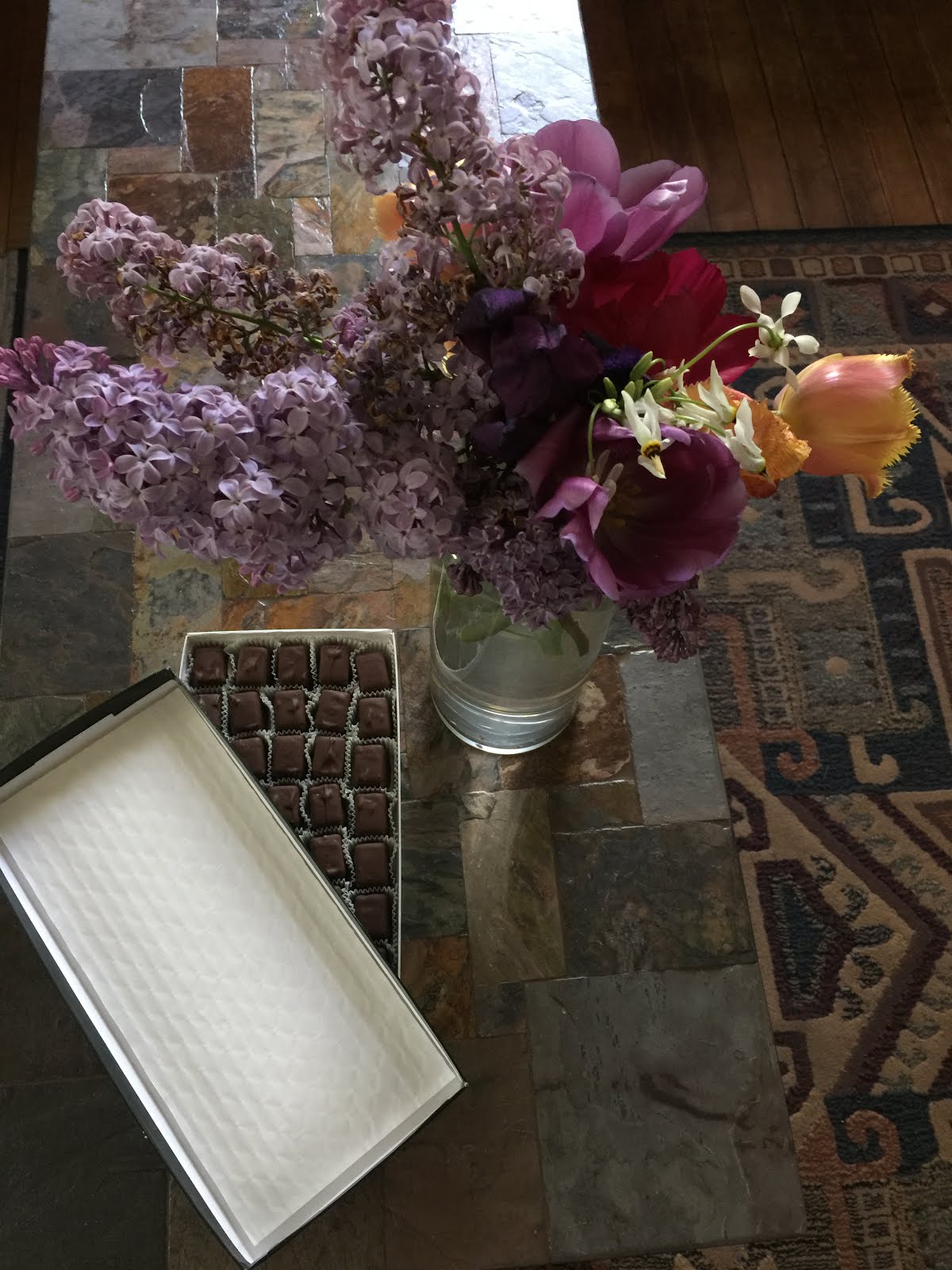
Picture, then inhale the scent, of your favorite flavor. Better even than lilacs, right? Chocolate offers poetry for the tastebuds, antidote for sadness, compensation for anxiety or stress. It’s also a reminder to everyone, including novelists, that enough is enough. 


Take details. Consider the many, many paragraphs of your novel that aren’t drama, action, or dialogue.  These fall into two general categories. 

Some narrative is immediately and directly integrated with the plot, thus creating or sustaining tension. Examples? Backstory, foreshadowing, some kinds of setting, or revelations of resources characters possess or lack. Description intrinsically linked to plot often zips along.

But a lot of the detail in novels has nothing to do with plot. Imagery and information often defeat tension. Still, novels would be mighty thin without description, symbolism, character nuance, and topics from art through zebras. 

Narrative, plot-oriented or otherwise, always affects pace, though the first  category far less than the second. That’s where chocolate comes in. First it fills your mouth with something besides your fingernails while you decide how much you need for clarity, reader satisfaction, and agent attraction. Chocolate soothes during the painful acceptance that you’re not a mindreader. Also, it warns that even something glorious can overwhelm, even nauseate, if over-indulged.  

You might consider all those add-ons that make fiction worth reading—and writing—as the sweet tang of chocolate: fantastic in moderation, but unappealing in smothering doses.

Tip: Too much, even of something quite wonderful, remains—too much.

Subtlety is key. According to Jerome Stern:
Serious writers, including comic writers, are interested in subtlety, in avoiding heavy-handed effects and obvious characterizations. They want to make readers pay close attention, and readers enjoy picking up on clues as subtle as a hesitation or a dropped glance.
Readers expect novels to order chaos, but not to remove every doubt. Readers want lots of chocolate, but not as the main course. These questions might help.
  • Do you leave space for reader imagination?
  • Do you overstate rather than imply?
  • Unsure whether readers “get it,” do you repeat once more, just to be sure?
  • Do you explain your metaphors?
  • Do your adverbs (“lazily,” crazily,” “dazedly”) “tell” what the dialogue already “shows”?
  • Do you ever overwhelm your plot with description or fact?
  • Do you write as if you have faith in reader ability to infer?
Thomas Mann observed that
Subtlety is the mark of confidence… A writer who is confident need not prove anything, need not try to grab attention with spates of stylism or hyperbole or melodrama… He will often leave things unsaid, may even employ a bit of confusion, and often allow you to come to your own conclusions.
In other words, enough chocolate to satisfy (which could be a lot!), but not to overwhelm.

Sunday, April 3, 2016

Don’t Name That Donkey

You know you want to. Perhaps you already have. Jenny or Jack, Don or Danielle, you worked hard to imagine every aspect of this scene. How big is the pasture, how decrepit the barn, how blue the sky, how scratchy the straw. As a novelist, it’s your job to visualize all that. But that’s not your primary job. What is? Deciding what distracts and cutting it.

So. If Donatello merely shakes off flies rather than motivating or executing the upcoming murder, we don’t care that he prefers clover to alfalfa. And he doesn’t need a name.

Tip: The fact that you created or discovered it doesn’t mean that you should include it.

Why not omit all the extraneous material that clogs novels? Here’s a start:

~ Heaps of adjectives.
            Do you really need more than one? If it’s the right one?

~ Personal memories.
            Does this matter to the story, or only to you?

~ Fun facts.
            Do they make your novel more fun—or less?

~ Repetition.
            Do readers really want watch another character learn what readers already know?

Lack of focus blurs narrative—any kind of narrative. Aristotle laid this down in The Poetics, where he said that fiction imitates reality, but not exactly. 

That’s because story is orderly rather than chaotic; it transforms random details into a credible and causal pattern that an audience can follow. Excessive or irrelevant detail, however fascinating, interferes.  Unless specifics add tension or clarify causality, they actually subtract.

In an intriguing twist, playwright/actor Sean Grennan served on a jury and offered attorneys advice on how narrative engages and persuades. Here’s an excerpt from “Unsolicited Advice,” published in The American Bar Association Journal:

If your practice involves talking to a jury, then your profession is storytelling….Rule # 1: (Less is more. (See also: Try not to bore us.)… In good storytelling, anything that’s not your friend is your enemy, just like Thanksgiving with your family.
Take that wonderful, genius, world-changing, vivid detail you’ve come up with, and if it is a digression, delete it. Anything that slows or distracts or confuses is a problem.

Like the name of that donkey. Make your case. Delete clutter. Let your primary characters breathe and act—without Darcy the darling, dappled, dimple-cheeked, dreamy, drama queen.

Sunday, December 29, 2013

New, New, New, New, New

We’re starting a new year, which arrives with a flurry of resolutions, hopes, and dreams about a new start. Nu? What have you done to make your novel “new” lately? If you haven’t, perhaps you’d like to. Because our word for the long narrative comes from the Latin “novellus,” meaning, of course, “new.”

A novel that does nothing new is last year’s news. While it’s truer than ever that “there is nothing new under the sun,” it’s your job to make your novel feel new. These strategies might get you started.

~ Opening.
Link the setting and atmosphere to the dilemma, and any location or conflict becomes original.

~ Plot
Dig deep. As Don Maass frequently reminds, the first nine twists you generate will most likely lack the punch of the ones you brainstorm following that.

~ Character
Whore with a heart of gold? Quarterback who wants to make it big so he can save his family? Whores and quarterbacks—why not. Stereotypical ones? Uh, uh. Make one major change, be it status, dreams, occupation, even gender. Shake things up.

~ Syntax
Sentence structure is important and it’s not necessarily instinctive and English teachers aren’t the only ones who loathe run-ons and so you should get out of the rut. Vary. Change patterns. Transcend habits, even if that requires conscious, concerted effort.

~ Imagery
Roses are red. Skies are blue. Tears equal sad. Spring equals happy. Roses come in a rainbow of colors, as do skies. And character tears can make readers quite sad—for the wrong reason. Can’t find anything new for your scene? Turn it upside down. Probe its core. That’s where the imagery you need is hiding.

~ Climax.
If readers have expected a set scene for a couple hundred pages, don’t rob them of that pleasure. Still, satisfaction blends the predictable with the startling. One perfect detail will get the job done. Again, the secret is discarding the first dozen or so possibilities. The great ones come from thinking long and hard enough.

Tip: Resolve to find ways to make your novel “new” in this new year.


Have a happy one.