Showing posts with label tension. Show all posts

Sunday, May 13, 2018

Plan to Keep the Plot Pot Boiling

If only you could add the right ingredients and without watching the flame, maintain a roiling, steam-producing rhythm without the flame rising too high or sinking too low. But more cooks can smoothly simmer spaghetti than writers can instinctively reach The End with optimal heat.

Fortunately, there’s a straightforward (though not necessarily painless) method every writer can use. And it’s easier than boiling an egg.

The answer is an outline, but a unique one. Novelists frequently associate outlining with the first draft, since a plans promotes credibility and causality from the start. Besides, if you get stuck, as often afflicts the novel’s middle, at least you know where you thought you were headed.

Useful as such can outline is, it won’t help you assess tension. Here’s something that will:

For each scene, complete first I then II. Because you want to focus on conflict,  it’s crucial to start with the obstacle, desire, force, or change driving the scene. Hint: verbs best express that.

I. Write one brief, non-detailed, super-short sentence that captures what the scene’s point of view character wants—or doesn’t. Here are a few examples:

     Abe covets Beth’s reassurance that their marriage remains sound.

     or

     Carol fears humiliation if Don dismisses her flirtation as ridiculous. 

     or

     Ed agonizes over Dr Fred sharing only part of the medical truth.

* Part I reflects tension and suspense. Passion, sexual or otherwise, is always involved. 

2. A brief contextual statement of where the characters are and what happens. Such as:


    Beth arrives late at the restaurant she reluctantly agreed to and leaves Abe there alone.

    or

    Don ignores Carol rubbing herself against him during a study session at the college library.

    or

    Dr Fred admits that Ed is ill but refuses details even when Ed insists.

* Part II is context. It’s where the characters are and what happens to them.

Like most things, this technique gets faster and easier with practice. Stick with it, though, and you’ll have a way to evaluate whether each scene possesses the oomph to be a scene. More important, you’ll not only know what happens, but what matters. Readers choose fiction for the emotion it evokes, and that comes from—high stakes.


Tip: Whichever method you choose, assess the tension in every scene of your novel.

Saturday, March 24, 2018

Scene: The Big Picture

In a way, every scene resembles a bouquet. Individual elements compose both. The end result must offer a coherent whole with a clear yet unobtrusive focal point. When the elements complement each other, the totality becomes far more effective than a single contribution. It’s the difference between this:


and this:


No one would mistake a couple of flowers for a bouquet. With scenes, though, it’s less clear. Precisely what constitutes a scene?
A scene is a sequence of events that happens at a particular place and time and that moves the story forward. — Randy Ingermanson, “The Art and science of Writing Scenes”
Another slant on the scene comes from Jane Friedman:
A scene is a stylized, sharper simulacrum of reality.
Ideally, the scene integrates everything from both definitions. So a scene needs:

~ Tension.

Unless there’s substantial suspense, summarize instead.

~ Momentum.

The scene must contribute to character arc, or, again, wouldn’t summary be better?

~ Setting.

Although locale mustn’t dominate, characters need grounding. Always.

~ Artistry.

Along with drama, scenes need causality, propulsion, originality, and grace.

~ Credibility.

Only plausible characters and events evoke reader emotion. 

~ Focus.

Regardless of style or voice, tension is the crux of every scene.

Yet novelists conceptualize scenes differently. Drawn to setting or symbolism? You might disregard tension. Maybe you’re an action sort of gal. Will your characters be disembodied? Will you emphasize what they do and ignore why they do it?

Scenes work when novelists disregard personal predilection to provide the whole picture. Who wants a lopsided bouquet? 


Tip: Readers enjoy scenes that balance their elements—that complete the picture.

Sunday, March 4, 2018

Pattern and Surprise in Fiction

The relationship between convention and deviation, expectation and revelation drives fiction. That’s exhibited in the pattern of story that’s remained stable for centuries: conflict…development…resolution. Obviously, though, tweak the specifics and that pattern feels different every time. 

Dozens of other patterns also underlie fiction: the structure of the paragraph, the alternation between scene and narrative, the major character arcs, and the moods, moments, or memories that echo each other. 

All those components of fiction involve reader expectations, whether fulfilling them or adding tension and suspense by credibly failing to fulfill them. 

Lisa Cron’s superb blog—“A Reader’s Manifesto: 12 Hardwired Expectations Every Reader Has” (October 9, 2014)—identifies the most crucial reader expectations. What could be more important than how writers handle focus, empathy, pace, and plot? 

Yet, in every instance, the presentation of setting or symbol affects reader response to those critical aspects of fiction that Cron lists.

Tip: Revisit without merely repeating. This satisfies the desire for recurrence plus change.

So if you return readers to a completely parallel or symmetrical exchange, issue, or location, you’ll defeat reader expectations every time. If Taffy again confers with her mom about her husband’s unemployment, something must differ. Maybe Mom thinks it’s time to leave him, or hire him in dad’s factory, or have Taffy work there herself. 

Otherwise, the story feels static. And Jessica Page Morrell is exactly right that every scene captures a progression toward fulfillment of arc. How can that happen if the characters simply repeat what they said before with the same objects in the same place?

Nor can even a conversation with higher stakes occur in an unaltered location. Maybe Ernesto proposes to Tamilla--his gorgeous, ambivalent girlfriend—in a rowboat drifting on moonlit Lake Emerald. However magnificent Lake Emerald, readers will balk at returning there if everything looks identical. Instead, maybe thick storm clouds now hide the moon. Is this boat too old and creaky to be safe? Disgusted with Tamilla’s affairs, perhaps Ernesto’s ready to drown her? Or maybe she’s the one who wants to send a body somewhere the police won’t easily find it.

The need for modification also applies to symbolism. If Gram gave Ernestine an exquisite hand-woven shawl, don’t simply over and over mention the shawl—or the chandelier or the tennis racket. Instead, use symbolic objects to represent how the plot thickens. Does the wood stove scorch the shawl? Must the impoverished family sell their chandelier? Despite the racket that belonged to Albert's renown uncle, does the boy still lose the state championship? 

Things don’t stay the same, though in life, it might feel as if they do. Fiction readers seek the credibility and pleasure of experiencing both the pressure of time and the possibility of growth and catharsis. Meeting those apparently conflicting expectations of familiarity and evolution may not be as difficult as it seems. As Susan Dennard reminds, 

You’re a reader too, so when you go back and read your story from start to finish, you’ll be able to sense if you’re meeting expectations or not.


And variation is a terrific tool for accomplishing that.

Sunday, February 25, 2018

Micro-tension: What Is It and Why You Care

Many novelists know about the need for “tension on every page.” How do you get that? Micro-tension, as Donald Maass explains in The Fire in Fiction:

Keeping readers constantly in your grip comes from the steady application of something else altogether: Micro-tension. That is the tension that constantly keeps your reader wondering what will happen—not in the story, but in the next few seconds. 

The April 19, 2009 “wordswimmer” blog adds

the term alone–-micro-tension–-implies a larger tension in a story, say, macro-tension, which in turn suggests two levels operating within the story simultaneously.

So the novelist is juggling, but juggling more than pure action. 

In a December 13, 2012 interview with Michael A. Ventrella, Maass elaborated on micro-tension:

Tension is not about action, explosions and shouting. It’s about generating unease in the mind of the reader. There are many ways to do that, many of them subtle. Even language itself can do it. When tension exists in the mind of the reader there’s only one way to relieve it: Read the next thing on the page. Do that constantly, on every page, and readers will read every word—you have a “page turner,” no matter what your style, intent or type of story.

Clear now? But of course you need to not only to understand the concept but apply it. Here are some strategies for accomplishing that.

~ Crisp details.

Less is more. Give readers lots of information, particularly at moments of high suspense, and you elicit thinking when feeling is the goal. Watch where you position your exposition.

~ Hard-working dialogue.

If characters talk the way people do, you get the same lack of tension that often fills daily life. Also, as Sol Stein puts in Stein on Stein, give your characters “different scripts.”

~ Time crunch.

The ticking clock keeps readers as worried as characters. What if it’s too late?

~ Internal dilemma

Little is more suspenseful than a cornered character unable to choose between two impossible options. Torment your characters. Readers will love you for it.


TIP: Novels need both broad overall tension and incessant, immediate edginess.

Sunday, February 11, 2018

Hard-wired for Story

The organic world is mostly phototropic. Like plants and moths, people gravitate toward the light. In fact, the longing to stare at the sun can risk sunburned eyeballs, even damaged retinas. 


Without the deleterious side effects, storytelling has always wielded similar magnetism.

 Since humans have been humans, they’ve told stories. That’s because
According to Uri Hasson from Princeton, a story is the only way to activate parts in the brain so that a listener turns the story into their own idea and experience. — Leo Widrich,“The Science of Storytelling: Why Telling a Story is the Most Powerful Way to Activate Our Brains”
You’re a novelist in a world crowded with obligations and distractions competing for attention. When children—and grownups—beg “Tell me a story,” they want to hear a great one. How can the storytelling instinct help you attract readers and keep them engaged?

~ Tension.

It’s no accident that any writing coach will insist that it’s needed on every page. Interrupt the story, and you interrupt reader connection with it. That connection, of course, is why readers care about characters and why fiction has always been a means for cultural instruction: 
in order to motivate a desire to help others, a story must first sustain attention–-a scarce resource in the brain–-by developing tension during the narrative. If the story is able to create that tension then it is likely that attentive viewers/listeners will come to share the emotions of the characters in it, and after it ends, likely to continue mimicking the feelings and behaviors of those characters — Paul J. Zak, “Why Your Brain Loves Good Storytelling”
~ Causality

Unless each—each rather than some or most!—event in the novel determines what follows, the novelist offers the randomness of life rather than the meticulously shaped progression of story.
A story, if broken down into the simplest form, is a connection of cause and effect. And that is exactly how we think. — Leo Widrich
~ Universality

Different cultures certainly express human emotions differently. But the emotions themselves remain constant. That’s why stories let people vicariously bleed under the lash of slavery, recoil at the stench of a dragon’s breath, shiver in the trenches of a battlefield, or bask in the awe of a kiss from the spouse you’ve loved for fifty years.


Tip: The greatest stories spring from capitalizing on the human instinct for narrative.

Sunday, September 17, 2017

The Secret Spaces inside the Scene

Fiction requires vividness, suspense, and empathy. But do you leave readers enough room for an intimate experience of detail, tension, and emotion?

As Charles Baxter puts it, 
A novel is not a summary of its plot but a collection of instances, of luminous specific details that take us in the direction of the unsaid and unseen.
That’s subtext, which, according to A.J. Humpage, 
is the implied meaning or theme within the narrative. It can also refer to the thoughts, actions and motives of characters that are not always so overt.
If everything is “overt,” from the character’s loneliness to the cold moss where she rests her tear-stained cheek on a fallen tree in the Southeast corner of the Olympic National forest, then perhaps ironically, fiction becomes drab, tepid, and dispassionate. 

Tip: Spell everything out, and you deprive readers of the chance to participate.

In Wired for Story: The Writer's Guide to Using Brain Science to Hook Readers from the Very First Sentence, Lisa Cron observes that:
When you put together large numbers of pieces and parts, the whole can become something larger than the sum.…The concept of emergent properties means that something new can be introduced that is not inherent in any of the parts.
What’s this new entity? In the best novels, it’s the synthesis of every aspect of fiction: plot makes detail more vivid, context builds characterization, and description intensifies suspense. But there’s more. That’s your readers feeling, wondering, interpreting, and analyzing. Until “The End,” those responses change frequently. And if the writer succeeds, many of those conclusions will prove irrelevant or inaccurate. Do you want surprised readers? Give them some freedom.

When readers can infer, fiction imitates life. There’s no circumstance where we reliably have all the information. So if fiction leaves nothing to the imagination, a novel is not only overloaded and oversimplified, but unrealistic. 

How can you encourage reader participation?

~ Subtext in dialogue.

      People rarely say exactly what they mean. Your characters shouldn’t, either.

~ Metaphor.

     When symbolism works, it replaces setting dense enough to overwhelm plot.

~ Emotional overload.

      Provide clues that let readers experience what the characters do.

~ Focus.

     If your goal is intense drama or suspense, don’t let anything compete with that.


Instead of walling readers out with excessive description and explanation, let readers take the journey along with your characters—instead of getting it secondhand.

Sunday, May 14, 2017

Chocolate and the Novelist

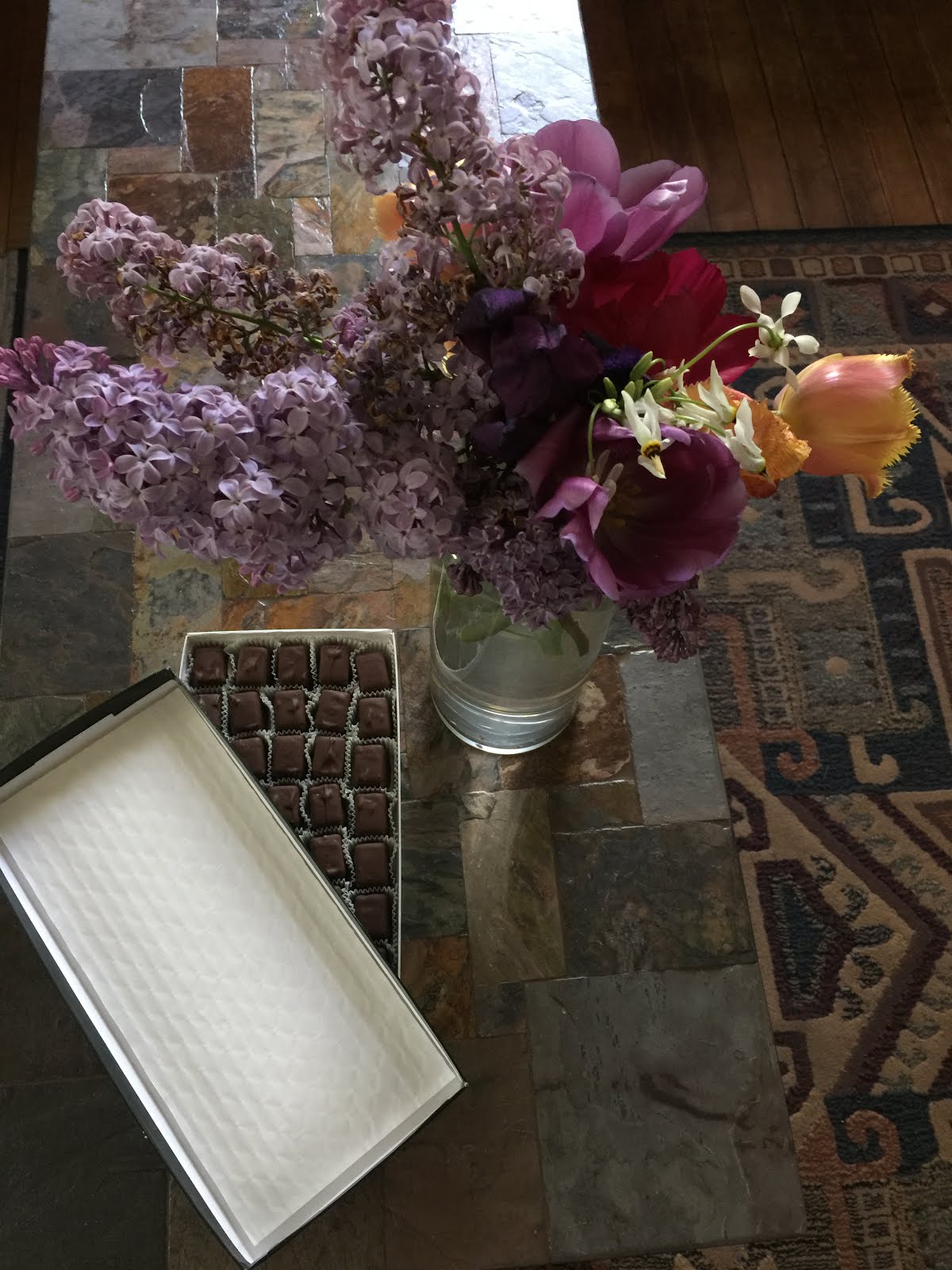
Picture, then inhale the scent, of your favorite flavor. Better even than lilacs, right? Chocolate offers poetry for the tastebuds, antidote for sadness, compensation for anxiety or stress. It’s also a reminder to everyone, including novelists, that enough is enough. 


Take details. Consider the many, many paragraphs of your novel that aren’t drama, action, or dialogue.  These fall into two general categories. 

Some narrative is immediately and directly integrated with the plot, thus creating or sustaining tension. Examples? Backstory, foreshadowing, some kinds of setting, or revelations of resources characters possess or lack. Description intrinsically linked to plot often zips along.

But a lot of the detail in novels has nothing to do with plot. Imagery and information often defeat tension. Still, novels would be mighty thin without description, symbolism, character nuance, and topics from art through zebras. 

Narrative, plot-oriented or otherwise, always affects pace, though the first  category far less than the second. That’s where chocolate comes in. First it fills your mouth with something besides your fingernails while you decide how much you need for clarity, reader satisfaction, and agent attraction. Chocolate soothes during the painful acceptance that you’re not a mindreader. Also, it warns that even something glorious can overwhelm, even nauseate, if over-indulged.  

You might consider all those add-ons that make fiction worth reading—and writing—as the sweet tang of chocolate: fantastic in moderation, but unappealing in smothering doses.

Tip: Too much, even of something quite wonderful, remains—too much.

Subtlety is key. According to Jerome Stern:
Serious writers, including comic writers, are interested in subtlety, in avoiding heavy-handed effects and obvious characterizations. They want to make readers pay close attention, and readers enjoy picking up on clues as subtle as a hesitation or a dropped glance.
Readers expect novels to order chaos, but not to remove every doubt. Readers want lots of chocolate, but not as the main course. These questions might help.
  • Do you leave space for reader imagination?
  • Do you overstate rather than imply?
  • Unsure whether readers “get it,” do you repeat once more, just to be sure?
  • Do you explain your metaphors?
  • Do your adverbs (“lazily,” crazily,” “dazedly”) “tell” what the dialogue already “shows”?
  • Do you ever overwhelm your plot with description or fact?
  • Do you write as if you have faith in reader ability to infer?
Thomas Mann observed that
Subtlety is the mark of confidence… A writer who is confident need not prove anything, need not try to grab attention with spates of stylism or hyperbole or melodrama… He will often leave things unsaid, may even employ a bit of confusion, and often allow you to come to your own conclusions.
In other words, enough chocolate to satisfy (which could be a lot!), but not to overwhelm.

Friday, April 28, 2017

An Outline of Outlining for the Novelist

Outlining was never meant to emphasize A, II, or b. When novelists ignore rigorous rules about potentially punctilious patterns or parallels, they can benefit from the focus, organization, and clarity that one’s personal, idiosyncratic version of a novel outline can provide.

As K.M. Weiland puts it in Structuring Your Novel: Essential Keys for Writing an Outstanding Story, “Examine your story. Where does it truly begin? Which event is the first domino in your row of dominoes? Which domino must be knocked over for the rest of the story to happen?”  Some form of outline is a useful strategy for checking such issues.

Tip: A relaxed version of an outline can aid the novelist during every stage of the process.

~ The preliminary overview.

You can save yourself time—not to mention stress—by sketching out the evolution of your protagonist’s journey. How much detail do you need? You’re the only judge. No one’s looking over your shoulder checking length or format. But do give yourself some goals.
  • What are the five of six pressure points that create your protagonist’s arc?
  • Where is the midpoint? In The Emotional Craft of Fiction, Don Maass calls this the moment when the protagonist can no longer turn back.
  • What’s the climax of your novel?
  • How does each scene advance the plot and keep the stakes high?
  • For each scene/chapter, what is the primary goal of the protagonist (or perhaps antagonist)?
  • Does each scene inevitably cause the subsequent one?
Though some writers consider outlining too confining, you needn’t obey your outline rigorously. The preliminary outline supports if you feel stuck and promotes a high-tension, causal movement from inciting incident to denouement. But are you on fire with new ideas? Follow them.

~ The post overview.

This is where you outline what you actually wrote, perhaps ignoring your initial outline entirely. 
  • If the novel has multiple points of view, who delivers each scene?
  • In what you actually composed, is there sufficient tension?
  • Does each scene both build from what precedes and escalate toward what follows?
~ The optional final overview.

Personally, I had great luck outlining my post outline to make it even more compressed. For me, this third step clearly revealed how to emphasize causality, escalate tension even higher, and omit scenes that didn’t earn their keep. 

However tedious, time-consuming or unnecessary outlining might seem, it’s one of the best ways (if not, in fact, the very best) to insure that each chapter/scene fulfills not just the author’s needs, but those of your story and thus your reader. Isn’t that worth the time?

Sunday, November 27, 2016

Giving Thanks for Readers

Without them, we’re just writing for ourselves. Would that be easier? You bet. Would that be preferable? Certainly not.

Tip: Whatever gets you to work harder gets you to work better.

If you don’t “show” when you ought to, make emotion genuine, plot causally, keep tension on every page, respect genre conventions, and word precisely, you can write as fast as you can type. But what kind of goal is that? Write for a reader, however, whether an individual (real or imaginary) or a congregation of them, and your standards rise to meet theirs. 

Here’s how:

~ “Showing” versus “Telling.”

Sadly, nothing about this is easy. If you never “tell,” readers can’t follow the story, even if it’s 250,000 words long, as will likely be the case. The trick is not to “tell” what you can “show.” Though there’s no formula, if a moment involves emotion, you probably want to reveal rather than describe. 

~ Genuine emotion.

Have you considered just how fake emotion can be? Watch commercials for greeting cards or pet food. Or a movie where one coincidence follows another until, thanks to a miracle save, the hero, through no resource of her own, lives happily ever after. Cheap. Fake, Shallow. Manipulative. In fiction, the only source of real emotion is real plot. 

~ Causal plot.

Don Maass has famously said that unless you construct a plot where no scene is expendable, you haven’t plotted the way you need to. Your not-so-secret weapon is causality. Every decision or action causes the next, nothing left to circumstance, nothing engineered from anything but character choices and assets. 

~ Tension on every page.

If the character (and thus reader) emotions stem from a causal plot that produces the outcome of every scene right up to the climax; and if events rather than abstractions like terror or agony deliver those emotions, then the tension will be right there. Let your characters and plot—rather than you the author—deliver the story. 

~ Genre Conventions.

This is where an image of a particular reader, representing a particular audience, really helps. For example, in fantasy or historical fiction, readers cheerfully tolerate so many characters that they’re offered—and willingly consult—lengthy lists of role and identity. But in genres like romantic suspense or women’s fiction, readers will balk at endless minor characters, no matter how melodic your voice or captivating your plot.

Read widely in your genre, and only current fiction counts. How people wrote mysteries when Agatha Christie reigned won’t necessarily tempt today’s mystery addicts. Do your homework. That’s neither cheating nor wasting time. After all, agents and publishers are, first and foremost, readers.

~ Precise wording.

This underlies everything readers seek. But it’s the last step—not the first.

Writers are a rebellious bunch. Many of us don’t instinctively appreciate constraints or critique. Of course you can ignore all that. Do your own thing. Just not if you want readers.

In this time when we need to count our blessings, if only to maintain our sanity, let’s count readers among those gifts. They keep us on our toes. They bring out our best. They remind us why we do this. And I, for one, couldn’t be more grateful. To our readers!

Sunday, October 30, 2016

Wait for it

“Timing is everything” applies as much to fiction as anything else.  It’s too late once the wave hits, the leaves fall, or the sun sets or rises, and too early isn’t much better. Timing is a powerful ally—or enemy.


Which factors affect a novel’s timing?

~ Starting too early.

No harm in writers warming up, setting the scene, submerging first toe, then ankle, then thigh into the dark cold of the empty page. If you must, write down what you’re thinking. Then cut. Mercilessly. Novels start with the inciting incident that propels the entire book forward and not with the backstory, context, or status quo leading to the inciting incident. The same applies to scenes. Begin in medias res, or in the middle of the action or tension.

~ Minimizing the best moment.

Like everyone else, writers frequently abhor conflict. Who wants to cause trouble, feel lousy, or send someone else there? But readers await that very tension. As Charles Baxter reminds, “Hell is story friendly.” Offer heated arguments, enflamed accusations, and burning lust or envy. Fire up your characters, then let readers watch the desperate attempts to stamp out the fire. Wait for the moment of most intense passion, then deliver it. Slowly and seductively.

~ Resolving too soon.

Few novelists enjoy torturing their beloved creations with misery, misfortune, or misanthropy. Rather than watch characters suffer, particularly the protagonist, writers often assume a gently maternal attitude. Let’s make things better. As soon as possible. Readers, though, want just the opposite. It’s not sadistic to find character struggle spellbinding. After all, how the protagonist changes and wins, who saves the day and how—isn’t that the entire basis for the novel? So, within each scene, wait for the moment of greatest conflict, and climax there.

~ Ending too early.

Just as the struggles the plot introduces need to play out till the end, the novel as a whole must let both the dilemmas and their solutions ripen. Harvest what’s immature, and nothing tastes good. When approaching the words “The End,” some novelists can’t wait to get it over with. But stop to consider the last novel you read that sagged at its conclusion. Wait until it’s time to let go, and then do.

~ Ending too late.

But don’t wait too long. Fruit satisfies when plucked at just the right moment, neither grabbed too soon, nor left to shrivel. Wait until you’ve nourished all the tension, and all the character change this provoked. Then stop.

Timing is tricky because so many factors urge us to wait too long or not long enough. Think about your audience. Imagine yourself as reader rather than writer. There’s no better way to discern when the moment’s right.

Tip: Time is a crucial, too frequently dismissed element of fiction.

Sunday, October 16, 2016

Wrong Turn, Right Result

Maybe you were booked for Capri and wound up on the Amalfi Coast instead. 


Or perhaps a visit to the Uffizi paintings became a tour of Renaissance Florence. You could fret, weep, or storm. But wouldn’t you rather appreciate what turned out, instead of what you planned?


You could be pleasantly surprised. This pertains to fiction, as well.

~ Wrong Turn with Your Characters

Don’t save every minor character you introduced just because they’re now “alive.”

Do seek ways to make three minor characters into one. 

Do add unexpected discoveries, which are nearly always the best ones. Did you accidentally discover that your Georgina enjoys Brussel Sprouts or Latin dancing? Who knew that Hector excels at chess, Judo, or solving the Rubric Cube?

~ Wrong Turn with Your Plot

Don’t keep broadening or, worse, repeating.

Do dig deeper. There’s no better antidote for nothing happening. Seek innovative solutions to stagnation. This might be another source of tension (as opposed to yet another character), or what Noah Lukeman calls “a ticking clock,” or an archetypal struggle, such as honor versus expediency.

Do think in terms of causality. How does this event or emotion yield? If your protagonist refuses to confront another character about betrayal, what is the result? And, as Don Maass instructs, avoid picking the first possibility that comes to mind. It comes first to everyone else’s mind, too.

~ Wrong Turn with Point of View

Don’t jump on the easiest solution.

Do use physical behavior or setting to convey the character thoughts that go beyond the scope of your chosen perspective. You might look up how Edith Wharton accomplishes this at the beginning of “The House of Mirth.”

Do pursue an alternative direction. What’s another way to communicate what your point of view can’t legitimately capture?

~ Wrong Turn with a Scene’s Opening

Don’t follow Alice into a nightmarish Wonderland just because you started that way.

Do start every scene with a hook. That’s a great way to know where you’re going before you get too far.

Do start the scene later. You’ll often speed momentum and raise tension by deleting the first few paragraphs.

Do experiment with variations. How else could this happen? Again, focus on cause and effect.

~ Wrong Turn with an Entire Scene

Don’t feel you should keep it just because you wrote it.

Do look for opportunities to collapse entire scenes into a paragraph or so of summary. When you do that, be concrete and explicit. Character emotions are a terrific way to collapse time, plot, or both.

Tip: Like most things in life, fiction benefits from making lemons into lemonade.

Sunday, September 25, 2016

Creativity and Constraint

Richard Powers, author of a several literary novels unrivaled in their beauty, says that "I write the way you might arrange flowers. Not every try works, but each one launches another. Every constraint, even dullness, frees up a new design."

According to evolutionists like the late Steven J. Gould, when it comes to developing new designs—like originating species, constraint breeds creativity. Put another way, we get to enjoy pearls because something irritated an oyster. The principle applies to writing as well:

Tip: Instead of dismissing difficulties, tackle them. That’s a plus for both reader and author.

So which constraints might writers sometimes disregard?

~ Clutter.

For many writers (certainly myself included), one of life’s greatest joys is words flowing so fast that your typing can’t keep up. Go for it. But afterwards? Remember that few constraints are more apt than “Less is more.” Tighten up. Lighten up. Challenge yourself to accomplish the task in fewer details rather than more.

~ Wordiness.

This involves not your details, but how you express them. William Zinsser reminds:

“I might add,” “It should be pointed out,” “It is interesting to note that”—how many sentences begin with these dreary clauses announcing what the writer is going to do next? If you might add, add it. If it should be pointed out, point it out. If it is interesting to note, make it interesting. Being told that something is interesting is the surest way of tempting the reader to find it dull; are we not all stupefied by what follows when someone says, “This will interest you” As for the inflated prepositions and conjunctions, they are the innumerable phrases like “with the possible exception of” (except), “due to the fact that” (because),” “he totally lacked the ability to” (he couldn’t), “until such time as” (until), “for the purpose of” (for).

~ Point of view consistency.

Yes, you’ll find plenty of contemporary novels (plenty!) that shift perspective whenever convenient. Should you imitate them? Only if you’re willing to lose what you’d gain by struggling toward a viable—and creative—strategy for inspiring yourself and pleasing your readers.

~ Tension.

You’ve likely heard, if not applied, some of these excuses: “Don’t readers want a lull?” “Why do mainstream/literary novels need conflict? Isn’t characterization more important?” “I write beautifully. Why worry about suspense?” And finally, “Even if I wanted all tension all the time, how would I do it?” Transform insufficient tension into an opportunity to develop “a new design.” Put your energy into momentum instead of rationalization.

Discouraged about self-editing? Feedback from others? Take any frustration you might experience and create a pearl. Goodness. If an oyster can do it, surely you can?


Sunday, August 7, 2016

Structure Your Scenes—All of Them

Coaches like Jack M. Bickham and Dwight Swain offer terrific suggestions for scenes, yet focus more on the building blocks than the writer’s perception of what happens next.

Tip: Plan your scenes to meet the goal of tension on every page.

Here’s an alternative: Character Goal…Hook…Hook.

~ The goal.
Know what your character wants. Instantly. Why can’t the character achieve this right now? And what’s the immediate result of failing?  “Instantly” and “immediately” are the key words. A casual, long-term possibility offers little at this moment. And readers, who have all sorts of other ways to spend their time, don’t want to wait. Don’t make them.

An added bonus: if you identify what your character desires, then you know where the scene needs to go. Win/win/win: characters get motive; readers get conflict; writers get strategy.

~ The hooks.
Use your protagonist’s goal to start every scene with a genuine hook, or anything that whets reader appetite.  Hint: it’s rarely just the setting. Consider these possibilities:

  • Seemingly unwinnable goal
  • Snazzy dialogue
  • Question
  • Short sentence that pops
  • Secret
  • Complex emotion
  • Huge dilemma
  • Grave danger
  • Emotional upheaval
  • “Ticking clock” (as Noah Lukeman put it)
Launch the scene with a hook, and conclude every scene but the last with another hook. Again, a bonus not just for readers, but for writers. Hooks help identify which material needs to be in scene while maintaining high tension right up to The End.

Now for the frosting. It’s often the writer’s motive, but less so the reader’s. Some examples:

Ø  Backstory
Ø  Themes
Ø  Symbolism
Ø  Allusions (literary or others)
Ø  Social commentary
Ø  History or geography or any other kind of “lesson”
Ø  Poetic moments

Like frosting, perfectly delightful. But in small doses, and never as a substitutes for the actual cake. The good news? Build scenes from hooks and goals, and you can add that delicious frosting without distracting from the plot. That’s where tension thrives.

Friday, July 15, 2016

Framing

You needn’t look closely to see that nature slips into compositions all the time. Out the window an oak dramatizes a sliver of moon and a single star. A staghorn fern fans itself across the glitter of mica-encrusted rocks.  Male and female goldfinches feed beside a six-foot-tall pure yellow lily. Nice.

But artifice, not nature, shapes the kinds of frames that novels need—the kind that add coherence and aesthetics to plot and tension.

~ Hooks.

Those of us raised on 19th century novels associate the hooks with setting, often a long, long, long, LONG description of something. But these days anyone can visit exotic places with a couple of clicks. Though E.M. Forster’s Passage to India is a great novel, today’s readers no longer a need a dozen pages on the Marabar Caves—or anything else.

Instead? Hook with drama, tension, secret, promise. Begin and end every scene that way. Want to integrate conflict with setting? Go for it. Just don’t forget the conflict part. That’s the hook.

~ Sequence.

            “A story is already over before we hear it. That is how the teller knows what it means”
(Joan Silber, The Art of Time in Fiction: As Long as It Takes). Her observation suggests how fiction exerts its power. Novelists comment on truth not just through plot and character, but time itself. So many options. Where does the story start? How much backstory would add, and where does it belong? Is the ending foreshadowed? Does the pace let readers savor what’s interesting and speed past what’s not?  The unwinding of time contributes to the frame embellishing the story inside.

~ Scene structure.
           
Whether you make a plan before you write (definitely not a bad idea), or revise what’s already written, every scene should frame a moment in time. Photographers choose what to include, omit, and emphasize; similarly, novelists can use the constraint of each individual scene to make this chunk of plot coherent, dramatic, and causal.

~ Set-off.

            Frames exist to enhance what’s inside. You might think of description, foreshadowing,
            backstory, and the prose itself as the framework supporting the plot. If any of those distract or
            diminish tension, then the frame overwhelms the part that matters.

~ Set-up.

            Reality is random. What’s great about novels? They aren’t. But only if the narrator frames the
            plot.

Tip: Frame your story. Great frames make what’s inside even more compelling.

Sunday, July 10, 2016

Characters with Character

We call oddball eccentrics “characters.” Yet character is also the possession of attributes, often moral, and characters are the individuals enacting a plot. Compile all these definitions, and you get—story.

Story harnesses entertainment to make morality easier to swallow. Based on that, your characters need equal parts moral fiber and zany individuality.  Those are the building blocks for making characters more “real” than real people.

In The Art of Fiction, John Gardner reminds us that “The primary subject of fiction is and has always been human emotion, values, and beliefs.”  The more your plot delivers that, then the more complex emotions your readers will experience. So you need conflict—big conflict, even the danger is exclusively psychological.

Adversity tests a character’s character. Will you answer the quest? Continue despite seemingly insurmountable odds? Earn the love, happiness, respect, honor, or victory that the antagonist mercilessly struggles to rip from you?

Robert McKee has said that the pressure the antagonist exerts brings out the best in a character. It also brings out the best in the reader, who begins wondering, “Would I fight that hard?” “Are my own struggles as weighty as those the protagonist faces?” “How can I not feel empathy for a battle of this magnitude?” How come the great human issues never change?

Your readers respond that way because of the emotional, causal, and moral nature of fiction. As Robert McKee put it in Story: Style, Structure, Substance, and the Principles of Screenwriting:

A character is no more a human being than the Venus de Milo is a real woman. A character is a work of art, a metaphor for human nature. We relate to characters as if they were real, but they're superior to reality. Their aspects are designed to be clear and knowable; whereas our fellow humans are difficult to understand, if not enigmatic. We know characters better than we know our friends because a character is eternal and unchanging, while people shift - just when we think we understand them, we don't.

Creating characters who are metaphorical works of art is a tall order. What makes that happen?

~ Breed empathy.
Your antagonist(s) can help.

~ Emphasize resilience.
            Who loves a whiner?

~ Celebrate morality.
Life is unfair. Should fiction be?

~ Liberate your characters.
            Unless you set them free, how can they surprise you or anyone else?

Tip: Don’t just incorporate tension. Use it to reveal and build character.

Sunday, April 10, 2016

Are You Omitting Someone from the Conversation?

Could be, unless both narrator and characters participate in dialogue. Why the narrator? Because despite substantial overlap in first person point of view, the narrator’s always a step ahead of the character. As storyteller, the narrator already knows the ending, and describes the trouble, rather than enduring it. Finally, the compassionate, insightful, charming, witty narrator can accomplish many things that characters can’t. Like speed up dialogue.

In rare instances, the tension soars and the dialogue is pitch-perfect. Then the narrator summarizing or describing would damage that white-hot pacing. Usually, though, you achieve optimal grounding, momentum, and insight when the narrator and characters create the illusion of conversation, which isn't much like an actual conversation. In this example from Saturday, Baxter and his accomplice Nigel hold an entire family hostage, including pregnant young Daisy:

Baxter puts his right hand in his pocket again.  “All right, all right,” he says querulously.  “I’ll kill you first.”  Then he brings his gaze back onto Daisy and repeats in exactly the same tone as before, “So, what’s your name then?”
          She steps clear of her mother and tells him.  Theo unfolds his arms.  Nigel stirs and moves a little closer to him.  Daisy is staring right at Baxter, but her look is terrified, her voice is breathless and her chest rises and falls rapidly.
“Daisy?”  The name sounds improbable on Baxter’s lips, a foolish, vulnerable nursery name.  “And what’s that short for?”
“Nothing.”
“Little Miss Nothing.”  Baxter is moving behind the sofa on which Grammaticus is lying, and beside which Rosalind stands.
Daisy says, “If you leave now and never come back I give you my word we won’t phone the police.  You can take anything you want.  Please, please go.”
Even before she’s finished, Baxter and Nigel are laughing.  -- Ian McEwan, Saturday

What if each character talked constantly instead of the narrator paraphrasing? What if you cut what the narrator adds to this passage? No, the narrator and characters must hold their own dialogue, with the narrator speeding, hinting, developing.

At the opening of Alice Hoffman’s Here on Earth, the mother and daughter have a brief exchange about being in a strange place, mired in the mud in an unpredictable car:

“We’re going to get stuck,” March’s daughter, Gwen, announces. Always the voice of doom.
“No, we won’t,” March insists.

Three paragraphs of narrator summary bring readers to the climax, omitting the obvious or redundant.

“We’ll get out of here,” she tells her daughter. “Have no fear.” But when she turns the key the engine grunts, then dies.
            “I told you,” Gwen mutters under her breath.

Tip: In dialogue and elsewhere, the narrator and characters must fulfill their respective roles.

Sunday, February 7, 2016

“V” Is for “Vivid”—Not “Verbose”

The internet revolutionized our assessment of “vivid” versus “verbose.”  

Do you ever skip description in a novel? I do, too. Obviously, merely describing how things look, sound, taste, feel, and smell is not, by itself, going to bring a location to life. Something more is required…Only through the eyes and heart of a character does place come truly alive.”  — Donald Maass, The Fire in Fiction

Neil Gaiman illustrates this in American Gods:

The house smelled musty and damp, and a little sweet, as if it were haunted by the ghosts of long-dead cookies.

That works. This does not: “The house smelled of must, dampness, and the sweetish smell of rot.” What makes one “vivid” and the other “verbose”?

  1. Originality.
Particularly when dealing with anything familiar—like a decaying house—transcend same-old, same-old. What’s the best source of that? Your character’s perception.

  1. Comparison.
This could be a metaphor, simile, symbol, or analogy. In all of these, successful comparisons arise from “an intuitive perception of the similarity in the dissimilar” — Aristotle, The Poetics.  Does the resemblance resonate at the deepest level? If so, readers instantly sense that a mockingbird or white whale or scarlet letter represents not only the literal but also a meaning beyond that.

  1. Insight.
Setting becomes meaningful when it reminds readers what they didn’t know they knew.

  1. Tension.
Setting should set up what’s ahead, and without “telling.”  In Kraken, here’s what China Miéville does with the sky:

The light was going: some cloud cover arriving, as if summoned by drama.

And Amy Tan with war in The Joy Luck Club:

But later that day, the streets of Kweilin were strewn with newspapers reporting great Kuomintang victories, and on top of these papers, like fresh fish from a butcher, lay rows of people—men, women and children who had never lost hope, but had lost their lives instead.

Images of “clouds” or “war” abound on the internet. So even incorporating all five senses won’t necessarily produce something “that readers will not skim,” as Maass reminds. Unless setting intensifies response to plot and character, it often feels “verbose.”

Tip: Setting becomes “vivid” only when it’s as integral to a novel as its plot.

Sunday, December 6, 2015

Purity and Impurity in Jonathan Franzen’s "Purity"

Depending on your definition of masterpiece, this novel might just be one. Pip needs love, money, and her dad’s identity—not necessarily in that order. Impurities and all, I want everyone to read it. So I won’t divulge any of its many secrets. Want the actual plot? Read this book!

It’s not perfect. In crystals, impurities alter the basic structure, adding color and fire; this describes Franzen as well. Some reviewers attack these distortions: self-indulgence, sexism, oversimplification, snobbishness, one-dimensional protagonists, and disconnected narrative threads.

There’s more. Tension can be as low as breadth is huge. The remarkable characterization occurs less from action than backstory. Lots and lots of “telling.”

Maybe. But here’s what else Purity offers:

~ Zingers.
 “Don’t talk to me about hatred if you haven’t been married.”

~ Analogy.
“It’s like having one red sock in a load of white laundry. One red sock, and nothing is ever white again.”

~ Insight.
“And maybe this was what craziness was: an emergency valve to relieve the pressure of unbearable anxiety.”

~ Irony.
“Stupidity mistook itself for intelligence, whereas intelligence knew its own stupidity.”

~ The “extra” in “extraordinary”:
“Fog spilled from the heights of San Francisco like the liquid it almost was.”

~ Voice.
“The tropics were an olfactory revelation. She realized that, coming from a temperate place like the other Santa Cruz, her own Santa Cruz, she’d been like a person developing her vision in poor light. There was such a relative paucity of smells in California that the inerconnecteness of all possible smells was not apparent….How many smells the earth alone had! One kind of soil was distinctly like cloves, another like catfish; one sandy loam was like citrus and chalk, others had elements of patchouli or fresh horseradish. And was there anything a fungus couldn’t smell like in the tropics?”

In an NPR interview, Franzen describes fiction-writing as expertly as he describes everything else: “It’s like having this dream that you can go back to, kind of on demand. When it’s really going well...you’re in a fantasy land and feeling no pain.”

You’ll need chutzpah to create that kind of “ fantasy land.” Here’s the thing about risk. Take none, and “good” is the most you’ll get. Defy “pure” convention, and you might fail; you might inspire loathing as well as adoration. Personally, I pray that Franzen keeps doing his own thing.

Tip: Too much risk is—risky. But none at all? No color or fire there.

Sunday, November 29, 2015

Turkey or Tofu, Tenderness, and—Tension

Whatever your personal protein, your novel needs both the fondness and frustration that describes any family gathering. The interplay between those? That makes novels tick.

Holidays expose the best and worst in everyone, including novelists. The bigoted uncle, the family mythology about who’s smart or successful, the Brussels Sprouts with cinnamon (?)—fodder for Charles Baxter’s observation that “Hell is story friendly.”

Yet fiction always needs a touch up, whether describing Thanksgiving or anything else. Colum McCann believes that “literature can make familiar the unfamiliar, and the unfamiliar is very much about the dispossessed, and so the value of literature seems to me to go into the stories that not everybody wants to tell.”

Those stories range from those living on the brink, in the streets, or simply starved for the Norman Rockwell painting we worry that everyone else is enjoying.

Tip: Tension resides in the irony between expectation and reality.

Some novelists enjoy adding tension as much as encountering Aunt Agatha, who blissfully reminds you that you’ve neither published nor married. What’s wrong with you?

That’s tension all right, and as Jodie Renner reminds, “All genres of fiction, not just thrillers, suspense novels, and action-adventures, need tension, suspense, and intrigue to keep readers eagerly turning the pages.”

Ready to write fiction as rich in tension as holiday food has calories? Here’s how:

~ Desire.
            That starts it all. Someone wants something apparently unattainable.

~ Change.
            That desire involves giving something up, even if it’s only the harbor of the familiar.

~ Twist.
Corey would like to be rich and adore everyone in her family. Yawn. Wouldn’t we all? Astonish us with how Corey’s longing both resembles and differs from everyone else’s.

~ Secret.
No one cares that Corey salted the filling instead of the caramel crust. But planning to offer herself to her brother-in-law? That’s a secret, like what you deliberately omit:

what creates tension . . . is partly the way the concrete words are linked together to make up the visible action of the story. But it’s also the things that are left out, that are implied, the landscape just under the smooth (but sometimes broken and unsettled) surface of things. – Raymond Carver

Yes, “All happy families are alike; each unhappy family is unhappy in its own way” (Leo Tolstoy). Fiction needs idiosyncrasy, universality, and tension. That needn’t deter renewed hope that the next holiday will exceed your expectations. And why not? The cycle continues...