Showing posts with label detail. Show all posts

Sunday, March 11, 2018

The Arithmetic of Fiction

Few novelists ponder the addition and subtraction of storytelling. But writers can gain a lot from doing so.

Tip: A novelist’s single best editing tool is a metaphorical scissors.

As Louise Brooks puts it, "Writing is 1 percent inspiration, and 99 percent elimination."

Anton Chekhov agrees: "Brevity is the sister of talent."

Dozens of writers have commented on economy, so this blog could offer endless examples. Since that seems painfully ironic, on to the next topic.

Tip: A novelist’s second best editing tool is adding metaphorical bridges when needed.

Those bridges are called transitions.

Transitions are words or phrases that carry the reader from one idea to the next. They help a reader see the connection or relationship between ideas and, just as important, transitions also prevent sudden, jarring mental leaps between sentences and paragraphs.  — Leah McClellan, “Why transitions are important in writing”
Novelists want readers to savor the story without the unpleasant reminder that they’re reading one. So not just any transition will do.
transitions move the story forward cleanly and seamlessly. Done skillfully, your reader will hardly notice the breaks. — “All Write Fiction Advice”
Few of us build those bridges instinctively. How to accomplish that? First, identify the connection that never got onto the paper. Second, integrate that transition into the narrative.

Tip: Excess disguises what matters, not only for the reader, but also for the novelist.

In an odd psychological quirk, novelists often assume that the fictional journey needs whatever they wrote. Why else would they record it? This takes a lot for granted. Details might repeat, wander off topic, waste words, or explain the obvious. In a cluttered passage, how would you know? Inefficiency masks significance.

If clutter buries, you won’t notice the leap you require readers to take between one scene or moment or paragraph or sentence and the next. Cut superfluous dialogue or description, and the landscape of your fictional world becomes visible. Now you’re ready to build bridges.


Subtract enough, and it all adds up.

Sunday, October 22, 2017

On Taking Time and Leaving Space

Exploit opportunity. That’s one distinction between good fiction and great. Sometimes, instead of faulty plotting or limp prose, the issue is timing. Let’s say the protagonist and hunky guy have been flirting for over two hundred pages. When he—and she or he—finally finish the chablis and hit the sack, why rush that? And you certainly don’t want to summarize, as in, “They had the greatest time ever.”

And in order to deliver optimal emotional and dramatic impact, maybe you can do even more. Whoops, someone has an asthma attack or breaks out in hives. Does the estranged spouse return for a heart-to-heart, courting interruptus? What about the cat, the dog, the teenage daughter? 

Go for the extra twist, never settling for the obvious. Then, develop the events that fulfill and startle readers—that haunt forever. Pause to think of your favorite moments in fiction. Are they ever ordinary? Rushed?

Be careful, though. Capitalizing involves a sort of tightrope between underdone and overwrought. To avoid the latter, watch out for these:

~ Stay subtle. 

Add vigorous and original events and details, not familiar or melodramatic ones.

~ Encourage inference.

Fiction thrives on hinting and suggesting, not clarifying or explaining. Which doesn’t, of course, mean you want confused readers.

~ Say it right the first time.

 Then you won’t be tempted to repeat, which usually frustrates more than it emphasizes. 

~ Slow down the good parts.

Writers tend to meander through detail, then zip through action and drama. Why? The humdrum and non-confrontational amass quickly,  not to mention more comfortably. Often, though, the scenes writers find most challenging are those their readers find most enchanting.

~ Carve out a space.

Don’t clog critical moments with layers of description or filler. Instead? Create a sort of pause-and-catch your breath moment. To illustrate, say a mother is awaiting news of her soldier son. Why not delineate her facial expression, the worry in her eyes before learning the truth? This delaying tactic prompts the reader to experience suspense along with her, to internalize the magnitude of a moment that resembles a mini-climax. How else will readers notice?

~ Set up.

Then always deliver.

As you move through the world beyond your novel (remember that one?), observe the reactions of people—and yourself—to momentous moments. Then you’ll have a better sense of how to time and design such moments in your fictional world.


Tip: Capitalize on the subterranean—not at all obvious—opportunities your novel offers.

Sunday, August 20, 2017

It’s Not a Dream!

Fiction is neither as long-winded, random, or forgettable as the scraps of stories that visit us during the night.  The novel’s achievement starts with the creation process that John Gardner describes:
In the writing state—the state of inspiration—the fictive dream springs up fully alive: the writer forgets the words he has written on the page and sees, instead, his characters moving around their rooms, hunting through cupboards, glancing irritably through their mail, setting mousetraps, loading pistols. The dream is as alive and compelling as one’s dreams at night, and when the writer writes down on paper what he has imagined, the words, however inadequate, do not distract his mind from the fictive dream but provide him with a fix on it, so that when the dream flags he can reread what he’s written and find the dream starting up again. 
This is narrative at its happiest and best—writing that gives readers a  world more dramatic, realistic and moral than daily routine. But the boundaries of this world are fragile. In fact, as Gardner points out, “one of the chief mistakes a writer can make is to allow or force the reader’s mind to be distracted, even momentarily, from the fictional dream.”

Those distractions come in many shapes and sizes, but the other kind of dreaming goes a long way toward explaining them.

~ Cliché.

If you’re gifted enough, of course it’s possible to write anything. But, for the most part, any version of “Henrietta woke, relieved that it was only a dream” won’t work. Dreams may be messages to the dreamer, but rarely to anyone else. If you want your novel to delight others, everything must seem new, starting with the plot and ending with the details capturing it. Cliches like waking from a bad dream? That is a bad dream. 

~ Grounding

Dreams let us fly out windows, land in foreign countries without deplaning, simultaneously chat with former lovers and elementary school teachers. If there’s anything fun about dreams, that’s probably it. But readers demand a fictional dream that, however invisibly, explains arrivals, departures, changes of location, and everything else that makes any world outside a dream clear, logical, sensible, and compelling. 

~ Credibility

In your nightmare, your patient and adoring Mama turns on you for no reason, viciously humiliating you in front of every teacher you encountered in your entire life. No wonder you can’t wait to wake up! But the point is that fiction, unlike dream, requires motive and causality. It’s logically true to itself. Anything else shatters the fictional dream that Gardner describes.

~ Pace

Often when we narrate our dreams (or are forced to hear someone else’s), events and details emerge with agonizing slowness. Trivia receives meticulous tedium, while grounding rarely arrives at all. In contrast, novels need momentum and context. Without those, readers doze off, blissfully escaping to the other kind of dream.

Tip: Dreaming is the first step for many writers. But it shouldn’t be the last.

Thursday, June 22, 2017

“Anguish” or “pain”? “Yearning” or “Desire”?

The difference? Less is more. For novelists, that notion never gets old, because most of us want more words, more syllables in those words, and more melodrama everywhere. And why not?

Because, Brendan Kenny puts it, 
Hyperbole and overstatement do more harm than good. Hyperbole is exaggeration. Overstatement is an attempt to convince your audience by bludgeoning them with facts, arguments, and pleas to get them to accept your assertion.
And this is as true for fiction as for law. In an interview with Roxane Gay, Joshua Henkin agrees:
I tend to gravitate toward understatement. My novels and stories are animated as much by what’s not said as by what’s said. It’s the silences in fiction (and in life) that, if rendered well, can be most illuminating.
Tip: The source of emotional engagement is putting readers in the moment instead of pushing them there.

Inflated or cliched language and description never involve readers the way these passages do:
My mother always says that fear and pain are immediate and that, when they’re gone, we’re left with the concept, but not the true memory—why else, she reasons, would anyone give birth more than once? I think I understand what she means when I look back on the night of the fire. Part of me knows that there was tremendous pain, that the heat of the blaze as it came down though the old village on the hill and Slavko’s farmland and our orange grove and ripped through the fig and almond trees, the pinecones sizzling like embers for what seemed like forever before they exploded, was unbearable; that to say that it was difficult to breathe is an impossible understatement; that the hair on my bare arms was already singed when the fire dropped down through the pines and rushed the brick wall. —Tea Obreht The Tiger’s Wife
You’re right there with the girl trying to beat back the fire. This connection happens because of the opening metaphor, the particularity of the details, the reflection after the fact, and the acute physical sensations. An understated portrayal of tragedy.

Understatement works equally well for joy. In Daisy Goodwin’s Victoria, the Queen Victoria’s new status terminates what could’ve been a budding romance, and she tells her prime minister:
“I was so happy … before.’”     “I find that happiness can always be recollected in tranquillity, Ma’am,” said Melbourne.      Victoria put her hands down and looked up at him, her pale blue eyes searching his face. “You were happy too?”     When Melbourne spoke, it was in the voice not of the urbane Prime Minister, but of a man of advancing years who is facing the loss of the only thing that is still capable of bringing him joy. “You know I was, Ma’am.” 
The Lord’s unadorned admission conveys everything Victoria needs to know, and through her, to those experiencing the scene vicariously. 

Shout, and you might get ignored. Whisper, and everyone will lean in to overhear. 

Sunday, May 14, 2017

Chocolate and the Novelist

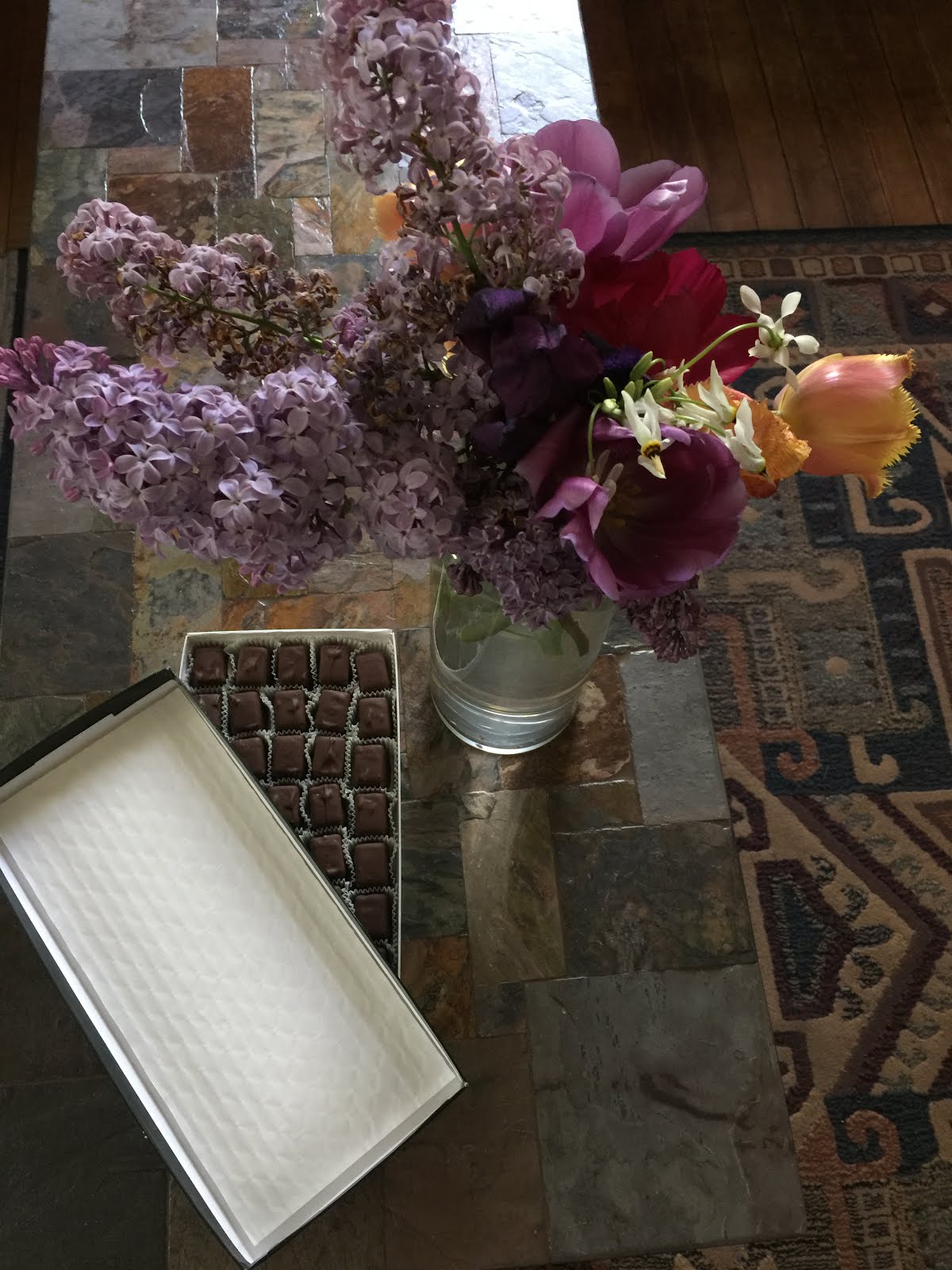
Picture, then inhale the scent, of your favorite flavor. Better even than lilacs, right? Chocolate offers poetry for the tastebuds, antidote for sadness, compensation for anxiety or stress. It’s also a reminder to everyone, including novelists, that enough is enough. 


Take details. Consider the many, many paragraphs of your novel that aren’t drama, action, or dialogue.  These fall into two general categories. 

Some narrative is immediately and directly integrated with the plot, thus creating or sustaining tension. Examples? Backstory, foreshadowing, some kinds of setting, or revelations of resources characters possess or lack. Description intrinsically linked to plot often zips along.

But a lot of the detail in novels has nothing to do with plot. Imagery and information often defeat tension. Still, novels would be mighty thin without description, symbolism, character nuance, and topics from art through zebras. 

Narrative, plot-oriented or otherwise, always affects pace, though the first  category far less than the second. That’s where chocolate comes in. First it fills your mouth with something besides your fingernails while you decide how much you need for clarity, reader satisfaction, and agent attraction. Chocolate soothes during the painful acceptance that you’re not a mindreader. Also, it warns that even something glorious can overwhelm, even nauseate, if over-indulged.  

You might consider all those add-ons that make fiction worth reading—and writing—as the sweet tang of chocolate: fantastic in moderation, but unappealing in smothering doses.

Tip: Too much, even of something quite wonderful, remains—too much.

Subtlety is key. According to Jerome Stern:
Serious writers, including comic writers, are interested in subtlety, in avoiding heavy-handed effects and obvious characterizations. They want to make readers pay close attention, and readers enjoy picking up on clues as subtle as a hesitation or a dropped glance.
Readers expect novels to order chaos, but not to remove every doubt. Readers want lots of chocolate, but not as the main course. These questions might help.
  • Do you leave space for reader imagination?
  • Do you overstate rather than imply?
  • Unsure whether readers “get it,” do you repeat once more, just to be sure?
  • Do you explain your metaphors?
  • Do your adverbs (“lazily,” crazily,” “dazedly”) “tell” what the dialogue already “shows”?
  • Do you ever overwhelm your plot with description or fact?
  • Do you write as if you have faith in reader ability to infer?
Thomas Mann observed that
Subtlety is the mark of confidence… A writer who is confident need not prove anything, need not try to grab attention with spates of stylism or hyperbole or melodrama… He will often leave things unsaid, may even employ a bit of confusion, and often allow you to come to your own conclusions.
In other words, enough chocolate to satisfy (which could be a lot!), but not to overwhelm.

Sunday, January 8, 2017

Getting to Know What Readers Know—or Don’t

Unless you enjoy clairvoyance along with creativity, you’ll never be certain what readers find baffling or belaboring. But you can develop significant skill at approximating, and the better your guesswork becomes, then the likelier you are to avoid dispensing too much or little. 

If readers have chosen your novel, don’t they want to hear everything you have to say? Of course not. 
Here’s the sort of thing they want you to omit.

“x.” What they’ve already heard.

Never be less aware of repetition than your readers.When writers revise over and over, as we definitely need to do, we sometimes forget what’s been established. This is especially treacherous when informing other characters about preceding events. Assume your readers are smart and have good memories. This encourages you to replace repetition with swift summary.

“x” Abstract description of emotions.

You “tell” every time you say, “Esmerelda was angry,” or “Romanov was sad.” Novelists frequently adopt such wording when transitioning from a general overview to a specific example. But that solves one problem by introducing another. Engage readers with body language and literal or symbolic imagery.

“x” Tedious logistics.

It’s charming that you can pinpoint the distance between the village where Prudence lives and the park where she makes love with Oscar in the bushes. Still, the lovemaking intrigues readers, not the park being 7.4 miles northwest of town, how long it takes to bike there, or even the exact number of hills Oscar must surmount to reach his beloved.

“x” Painful didactics.

Just because you know all about shipbuilding in ancient Greece, Caillebotte’s palette, or every detail about America’s greatest quarterback, don’t assume that readers also want to know. Never bury the plot or lose your voice. Instead? Integrate facts into the story itself, or use them as a delaying tactic to escalate suspense. Keep the emphasis on the fiction—not the “non.” 

Of course you must also guess what readers do want. That’s qualities like these:

~ Clarity.

Readers want to feel grounded. Who is this guy? When did the revelers leave the house? Where are we, and how did we get there?

~ Causality.

What induced this moment? Reveal motive not only through scene goals, pressure points, and character arc, but at the level of the sentence with words like “while” and “but.”  

~ Mystery. 

Manipulate details so that readers can frequently infer without ever feeling confused. That’s the not-so-secret secret to what readers want to know.

Tip: Successful fiction masters the delicate balance between inference and explanation.

Sunday, September 25, 2016

Creativity and Constraint

Richard Powers, author of a several literary novels unrivaled in their beauty, says that "I write the way you might arrange flowers. Not every try works, but each one launches another. Every constraint, even dullness, frees up a new design."

According to evolutionists like the late Steven J. Gould, when it comes to developing new designs—like originating species, constraint breeds creativity. Put another way, we get to enjoy pearls because something irritated an oyster. The principle applies to writing as well:

Tip: Instead of dismissing difficulties, tackle them. That’s a plus for both reader and author.

So which constraints might writers sometimes disregard?

~ Clutter.

For many writers (certainly myself included), one of life’s greatest joys is words flowing so fast that your typing can’t keep up. Go for it. But afterwards? Remember that few constraints are more apt than “Less is more.” Tighten up. Lighten up. Challenge yourself to accomplish the task in fewer details rather than more.

~ Wordiness.

This involves not your details, but how you express them. William Zinsser reminds:

“I might add,” “It should be pointed out,” “It is interesting to note that”—how many sentences begin with these dreary clauses announcing what the writer is going to do next? If you might add, add it. If it should be pointed out, point it out. If it is interesting to note, make it interesting. Being told that something is interesting is the surest way of tempting the reader to find it dull; are we not all stupefied by what follows when someone says, “This will interest you” As for the inflated prepositions and conjunctions, they are the innumerable phrases like “with the possible exception of” (except), “due to the fact that” (because),” “he totally lacked the ability to” (he couldn’t), “until such time as” (until), “for the purpose of” (for).

~ Point of view consistency.

Yes, you’ll find plenty of contemporary novels (plenty!) that shift perspective whenever convenient. Should you imitate them? Only if you’re willing to lose what you’d gain by struggling toward a viable—and creative—strategy for inspiring yourself and pleasing your readers.

~ Tension.

You’ve likely heard, if not applied, some of these excuses: “Don’t readers want a lull?” “Why do mainstream/literary novels need conflict? Isn’t characterization more important?” “I write beautifully. Why worry about suspense?” And finally, “Even if I wanted all tension all the time, how would I do it?” Transform insufficient tension into an opportunity to develop “a new design.” Put your energy into momentum instead of rationalization.

Discouraged about self-editing? Feedback from others? Take any frustration you might experience and create a pearl. Goodness. If an oyster can do it, surely you can?


Sunday, September 18, 2016

Write Tight--But "Right"

The title rhymes and all, but what might being “right” with your words mean? First, if your intended audience doesn’t enjoy it, something’s off. Take classic novels. Or, for many readers, don’t take them. Because, as Mark Twain put it, the classic is “a book which people praise and don’t read.” 

That’s not right. Neither is a book lauded for its brilliance but too incomprehensible for most of us to tackle. James Joyce’s Finnegan’s Wake may well be a masterpiece. But if hardly anyone reads it, did Joyce get it “right”? What’s intimidating or tedious is hardly a turn on. So.

~ Accessibility.

This plays a huge role in writing “right.” If readers neither understand what you’re saying nor care when they don’t, something’s very wrong.

~ Guidance.

Inference and confusion are two entirely different animals. The first may initially seem a bit unfamiliar. Yet it resembles something you want to understand; it suggests something positive, even if you haven’t figured it out yet. Confusion, though? That’s a nasty animal. It neither looks nor smells good. Tempt your readers with clues. Provide transitions. Give enough information, but not too much. Because that’s not such a delightful beast, either.

~ Tautness.

In Shakespeare’s Hamlet, Polonius the buffoon informs us that “brevity is the soul of wit,” then proceeds to go on and on. And on. And on. Point taken. Are you writing tight?

     Not if you’re smitten with passive voice.

     Not if you make the same point first generally, then specifically—or the reverse.

     Not if you adore (i.e. fall in love with) wordy verbs.

     Not if you usually use three words when one would do.

     Not if punctilious grammatical correctness clutters up your prose.

Correct forms like “has been competing” can feel as irritating as self-righteous political correctness in the real world. Be clear, not pompous or archaic.

Tight writing reduces clutter. Down with weak words (“is,” “be,” “am,” etc.); imprecise detail (three metaphors or images because each is inadequate); or clarifying what we prefer to infer.

That’s the script: clear, focused, taut. Tight yet right.

But here’s the thing about all those writing rules, no matter who espouses them As Picasso said, “Learn the rules like a pro, so you can break them like an artist.” How else can you—with a splendid blend of objectivity and passion—decide when to break them? 

Tip: Mediocre writers follow every rule. Good writers know when to break them.


Sunday, September 11, 2016

Pale Purple Bikinis and Green and Gold Styrofoam Cups

Starting in childhood, the message accompanying the pencil, or pen, or keyboard is uniform: be vivid. Be specific. Let us picture the moment. Bring on the detail. 

Yes. Yet too much detail can be as bad as—or even worse than—not enough. Excessive description, even when electric and exquisite, can weaken fiction. Because you can inadvertently introduce problems like these:

~ Confusion. 

On the first page of your novel, Marcy leaves the kitchen without offering her husband the customary “Have a good day” kiss. That’s the tension of the opening. Why doesn’t she kiss him? How will he react? Can the couple (and those reading about them) anticipate sweaty make-up sex in just a page or two? 

But what if you decide to add vividness by explaining that last night Hank offended Marcy by saying she looked kind of plump in that sweater. Perhaps you may to clarify that, not being a wordsmith, Hank only meant that the garment was rather risqué for the office. But do readers care that chartreuse is Marcy’s favorite color, the sweater has a boat neck, she wears it with matching earrings, or she managed to scoop it up at nearly 70% off? 

Such sentences are often difficult to compose and position. That might be because the sentence doesn’t belong anywhere. If you can’t place it or fix it, maybe you don’t want it?

~ Distraction.

If readers are captivated by Marcy hesitating outside the divorce attorney’s office, it might be the time to mention that both her maternal and paternal grandparents are divorced. Is it the right time, though, for a lengthy description of how her mother and father fell in love?

~ Blur.

One way fiction differs from life is that it’s a set of focused details rather than a random barrage of them. Reality forces us to sift through and decide what matters. In fiction, that’s the author’s job. 

Don’t you want to attract a reader who assumes that whatever you include is important? A reader who pays attention, because if it isn’t relevant right now, it surely will be later? If you want readers like that, then every detail has to count.

~ Repetition.

Details sometimes result in a general description, then a specific one. Or a specific, then general one. Neither of those works.


Tip: Less description? That’s sometimes more. When in doubt, leave it out.

Sunday, May 22, 2016

Dealing with the Devil in those Details

For novelists and everyone else, detail sometimes involves a trick, curve, mystery or problem that’s invisible until—it’s too late. The phrase evolved from “God is in the detail,” and the author of triumphant details certainly achieves a succinct universality unavailable to mere mortals.

Since details are the stuff that novels are made of, how does the devil infiltrate?

~ Tedium.
   
The less new you can make it, then the faster you should say it.

~ Melodrama.

If someone’s dying or a country’s being raped, resist the temptation to explain that this is horrible. Let vivid, understated details convey the point for you.

~ Repetition.

            Why say it specifically, then generally? Or the other way around.  This inadvertent habit
            insinuates condescension. In other words, it presumes that readers can’t figure it out
            without a few versions. So don’t patronize. Even accidentally. Even if you certainly never
            intended ill will. Or insulting your readers is the last thing you want. See how annoying it
            becomes in no time at all?

~ Self-indulgence.

With rare exceptions, detail enhances story only when it enriches character and/or plot. Make the setting reveal character and heighten tension.

~ Uniformity.

            Don’t keep piling up similar details. No matter how vituperative the villain or angelic the
infant or pure the snow, provide nuance and dimensionality.

~ Significance

“Literature differs from life in that life is amorphously full of detail, and rarely directs us toward it, whereas literature teaches us to notice. Literature makes us better noticers of life; we get to practice on life itself; which in turn makes us better readers of detail in literature; which in turn makes us better readers of life” (James Wood). Emphasize the details you want readers to notice. This sounds silly! But it’s easy to distract yourself with the vividness of an image or sound of a sentence and lose track of what matters about this scene.

~ Approximation.

“The truth of the story lies in the details” (Paul Auster). You annoy readers by
confusing the location of Times Square or crucial dates of  WWII. You also annoy
readers by trampling psychological and moral truth in the characters you create.

~ Fogginess.

“Nothing is less real than realism,” Georgia O'Keeffe observed. “Details are confusing. It is only by selection, by elimination, by emphasis, that we get at the real meaning of things.”  No matter how autobiographical your fiction, choose details to reveal pattern and cement credibility. Offer the focus that reality cannot.

Tip: If the detail isn’t adding, it’s subtracting.

Sunday, April 3, 2016

Don’t Name That Donkey

You know you want to. Perhaps you already have. Jenny or Jack, Don or Danielle, you worked hard to imagine every aspect of this scene. How big is the pasture, how decrepit the barn, how blue the sky, how scratchy the straw. As a novelist, it’s your job to visualize all that. But that’s not your primary job. What is? Deciding what distracts and cutting it.

So. If Donatello merely shakes off flies rather than motivating or executing the upcoming murder, we don’t care that he prefers clover to alfalfa. And he doesn’t need a name.

Tip: The fact that you created or discovered it doesn’t mean that you should include it.

Why not omit all the extraneous material that clogs novels? Here’s a start:

~ Heaps of adjectives.
            Do you really need more than one? If it’s the right one?

~ Personal memories.
            Does this matter to the story, or only to you?

~ Fun facts.
            Do they make your novel more fun—or less?

~ Repetition.
            Do readers really want watch another character learn what readers already know?

Lack of focus blurs narrative—any kind of narrative. Aristotle laid this down in The Poetics, where he said that fiction imitates reality, but not exactly. 

That’s because story is orderly rather than chaotic; it transforms random details into a credible and causal pattern that an audience can follow. Excessive or irrelevant detail, however fascinating, interferes.  Unless specifics add tension or clarify causality, they actually subtract.

In an intriguing twist, playwright/actor Sean Grennan served on a jury and offered attorneys advice on how narrative engages and persuades. Here’s an excerpt from “Unsolicited Advice,” published in The American Bar Association Journal:

If your practice involves talking to a jury, then your profession is storytelling….Rule # 1: (Less is more. (See also: Try not to bore us.)… In good storytelling, anything that’s not your friend is your enemy, just like Thanksgiving with your family.
Take that wonderful, genius, world-changing, vivid detail you’ve come up with, and if it is a digression, delete it. Anything that slows or distracts or confuses is a problem.

Like the name of that donkey. Make your case. Delete clutter. Let your primary characters breathe and act—without Darcy the darling, dappled, dimple-cheeked, dreamy, drama queen.

Sunday, March 27, 2016

Question Whether You Question Enough

Tip: Nonfiction is for answers. Fiction is for questions.

Certainly, fiction has much to teach, and not just about society or morality, but also about ornithology, teen pregnancy, Victoria’s reign, the Song of Songs, and so on. But if fiction accomplishes this teaching with a sound that’s overtly educational, most readers close the book. What’s the solution? Questions.

The questions that propel fiction originate in the writer’s own questions:

~ Who is the audience?
~ Why struggle through this when I might make more money at McDonald’s?
~ Does my plot deliver my theme?
~ Wait. Do I have a theme? If not, do I need one?

Start there. Then consider your writing lifestyle. Maybe, like many writers, you’re addicted to critique, conferences, coaching, and a canon composed of brilliant minds like John Truby’s, Robert McKee’s, Donald Maass’s, John Gardner’s, and so on. Great!

Yet instruction doesn’t necessarily pose questions the way that good feedback does. Do you let rules or explanations bury the fundamental questions?

Whether you struggle with your first or twenty-first draft, work alone or with a group, certain questions always apply:

  • Is your scenario original and electric? Too good to ignore?
  • Does at least one character evoke empathy?
  • Do you capitalize on your point of view?
  • Do you open the first chapter, and every chapter and scene thereafter, with a big bang?
  • Do the details support the story, or mostly your own subjective interests?
  • Do you dramatize what’s truly exciting, and summarize what isn’t?
  • Does your plot keep readers turning pages?
  • Is your story more important to you than your readers are? (Oh, oh.)
  • Are too many of your sentences annoying?
  • Does your novel ask more questions than it answers?
The best fiction leaves us with questions. Nathaniel Hawthorne wonders whether hypocrisy is more contemptible than adultery. F. Scott Fitzgerald invites us to decide what the past means. Harper Lee asks if we ever considered the connection between innocence versus racism or sexism. Tracy Chevalier questions whether we noticed how many women influenced a history peopled with men. Jonathan Franzen speculates on the meaning of “purity.”

If you prefer answers to questions, is fiction the best genre for your tastes and talents?

Sunday, December 20, 2015

Ouch!

Would you rather remove the Band-Aid slowly—or just rip it off? Would you rather slowly discover which aspects of your novel warrant revision—or get it over with? No right answer exists. It’s your choice, but it is a choice, and remembering that might help.

Tip: Why not be completely honest with yourself so you can be honest with your critiquers.

Most writers agree with Kenneth Blanchard: “Feedback is the breakfast of champions.” Writers usually insist that if they respect the critique, they’ll take the entire candid yet considerate assessment, and all at once. But rationality and ego don’t always match.

Like everyone else, writers often experience disparity between what they think they ought to want and what they actually do. In our secret writer hearts, we want to hear, “This is glorious! I wouldn’t change a single word.” But how often is there no room for improvement? Are you willing to keep some realities in mind?

~ Trust.

Heed criticism only from those who are not only insightful, but unquestionably in your corner. A constructive critique, “like rain, should be gentle enough to nourish a man’s [sic] growth without destroying his roots.” -- Frank A. Clark

~ Flexibility.

The suggestion turns you off: it’s not what you meant, doesn’t emphasize what matters, misses the point. That isn’t carte blanche to simply dismiss it. Critique provides opportunity to revise so you can accomplish what you intended. Start with being super- choosey about who critiques you. Those opinions matter. Dismiss them at your peril.

~ Defensiveness.

It’s natural. But it does need a time limit and, again, heaps of honesty. Part of you values The Work more than anything. The trick is letting that part triumph.

~ Pride.

If you know how hard you worked—with all the objectivity you could muster—then you know why you included that word, that detail, that climax. Then you can proudly say, “I need that.” Yet you also need greater objectivity than you can realistically generate. Which do you prefer: your defense or this reader’s “truth”?

Feedback is part of the package: “There is no defense against criticism except obscurity” -  Joseph Addison.

Chin up. As Konrad Adenauer observes, “A thick skin is a gift from God.” That’s because the better you listen, then the better you make your writing. Rumi was right that “Criticism polishes my mirror.” Isn’t that what you seek, even it involves “ouch”?

Sunday, September 20, 2015

Types: Stereotype, Archetype, Trope

Archetypes, stereotypes, and tropes are about equally elusive and significant. Does it matter if you’re sure which you use?  Classification’s unimportant. What matters? Lay a foundation with archetype; use trope to speed pace; avoid stereotype whenever possible.

~ Stereotype.

The etymology says it all. The word comes from the mold that made identical copies of the original. In life or the novel, stereotypes feel clichéd—uninspired. Worse still, generalizations about ethnicity, religion, size, education, hair color and so on ignore individuality. Stereotypes are misleading and harmful. How useful can they be in fiction?

Stereotypes are contrived writing solutions, while archetypes are the platform that tradition offers.

~ Archetype.

The archetype is the original mold used for the stereotypes that follow it. According to Carl Jung, roles like the Hero originate in the “collective unconscious.” We’re all in it together. (For more on this, check “The 12 Common Archetypes,” by Carl Golden.)

In The Writer’s Journey, Christopher Vogler analyzes archetypes as a source of plot from inciting incident to climax. Archetype underlies the classic plot: coming of age, abuse of power, love changing identity and history. Yet without your own original twist, the situation and its characters will seem stereotypical.

If the distinction between archetype and stereotypes is a bit fluid, trope is even more so, because it’s used in several different ways.

~ Trope

It can be a symbol (a rose equals love), a genre convention (“once upon a time”), a shortcut conveying plot or character (a stranger came to town), or an over-used device (the bossy, bespectacled librarian). Tropes range from very, very useful and efficient to very, very the opposite. While archetypes are universal, tropes often refer to a particular genre, like YA, Horror, Cozy, Western.

What does all this boil down to?

Tip: Tradition can both bring forth the richness of allusion—or the poverty of cliché.

How to know the difference? The easy answer is to solicit feedback. A wise, objective reader will let you know if you’ve united the benefits of both convention and innovation.

The harder answer lies in the details. Obviously, the over-familiar is tedious, manipulative, or facile. The “novel” part of the novel demands “something new under the sun.” Build on the conventional: archetype, trope, allusion.  Add to that dimensionality, mutability, individuality, and universality. You’ll have something good—maybe even great.

Sunday, July 12, 2015

Detail and Shadow

Most writers relish details the way they cherish words: how can you possibly amass enough? Yet details are like chocolate. Continue after you should quit, and the result is queasiness. Or worse.

19th century writer Thomas Bailey Aldrich said, “I like to have a thing suggested rather than told in full. When every detail is given, the mind rests satisfied, and the imagination loses the desire to use its own wings.”

Here in the 21st century “wings” are generally restricted to literal flight. The language has changed, but not its truth: the smallest possible number of precise details let readers engineer their own flights.

The right detail is worth ten or twelve almost-right ones. This isn’t just a matter of leaving readers enough space; it also involves perception.

The beginnings and ends of shadow lie between the light and darkness and may be infinitely diminished and infinitely increased. Shadow is the means by which bodies display their form. The forms of bodies could not be understood in detail but for shadow. ― Leonardo da Vinci

What underlies this observation? The significance of dimness, of ambiguity, of the part you have to squint to bring into focus—and it might still remain indistinct anyway.

The history of photography, of how we make imagery permanent, has much to offer novelists. Picture yourself in a darkroom, dipping the print-to-be in its bath, waiting for an image to emerge, waiting to see what you captured.  Even though we can now see what we capture as fast as our fingers can move, patience remains the fiction writer’s ally. Yes, it’s great to have 50 chances to get the shot. But you have let all of them go except the one that offers both shadow and light, that guides readers without blocking the view. Present all your attempts, and you’ve erased every shadow.

Keep” taking shots” until you achieve the picture that gives readers of what they sought in the first place: the privilege of discovering where the shadows begin. Here’s an example:

Helen made all well-formed sentences. But they were hollow and stuffed―linguistic training bras. She sorted nouns from verbs, but, disembodied, she did not know the difference between thing and process, except as they functioned in clauses. Her predications were all shotgun weddings. Her ideas were as decorative as half-timber beams that bore no building load. ― Richard Powers, Galatea 2.2

Powers gives us lots of metaphors, each providing a clue to what’s missing. The details make this happen: “training bra,” “noun” or “verb,” impetuous marriage, and “beams” that offer no support.  In about fifty words, readers discover something about Helen, the person describing her, and the discomfort of non-communication. He loves metaphors—and many of us love him for that! Because the metaphors are never definitive—only suggestive. Each reader can interpret a little differently. Grant your own readers that opportunity.


Tip: Leave room for the shadows.

Sunday, May 17, 2015

A Tale of Two Questions

You can reduce many questions about writing your novel to just two:

1.      Do readers want to experience this as a live-time scene?
2.      Do readers want these contextual details, and if so, earlier, now, or later?

Tip: Question what your readers want, and when. It won’t make you clairvoyant. It will improve your ability to meet reader needs.

1. Start with scenes.

Novels can’t survive without them. What must they accomplish?

~ Direct access to the characters.
Sol Stein, in Stein on Writing, reminds us that “scene happens in front of the reader, is visible, and therefore filmable.”

~ Lack of resolution.
According to Jack M. Bickham in Scene & Structure, scenes are for characters struggling toward their goals, not for achieving those goals. 

~ Psychological change.
Author and writing coach Jessica Page Morrell says that scenes change characters. Unless there’s enough pressure to force that, maybe it shouldn’t be a scene?

2. Connect your scenes.

Background and context are the glue that sticks scenes together. Readers want who, what, where, when, and why, and neither so early that the information seems cluttered and irrelevant, nor so late that they’re already confused.  It’s all in the strategy.

~ Connect details to what’s happening in the novel right now.
Sometimes you have to delve into the past. Always use that to escalate present-time tension.

~ Disperse gradually.
Info dumps, if they belong anywhere at all, are for textbooks. Respect reader attention span.

~ Keep action prominent.
Sense of place is crucial, but not necessarily as the start to every chapter. A hook pulls in the reader while reminding the writer where the scene is going.


Question the contents of your scenes. Question the details connecting your scenes. The answers help create the illusion that your novel is perfectly paced. Isn’t that worth a question or two?

Sunday, April 12, 2015

A Rose in a Cornfield Is a…

…weed. Misplaced, the most exquisite, evocative addition feels like…a mistake.

We’ve all experienced it:  “What a sentence! I love it! I can’t even believe I wrote it! Must’ve come directly from the Muse.” And yet, if you can’t find the right location for that fantastic sentence, you must let it go.

It helps to view your novel as a limited area of ground. You want to make the most of every inch, not let things that don’t belong there insidiously sneak in.

Don’t

…realize that readers need to know something and leave it wherever you happened to think of it.

…interrupt the action with distracting backstory or description. Note that distraction differs from
slowing down—teasing out suspense. The former is accidental, the latter deliberate.

…weigh down your story with detail that feels as relevant as Aunt Agatha’s best friend’s grandma’s traditional recipe for last-till-spring Christmas Fruitcake.

…add a brief passage about the Galapagos Islands because you did lots of research on it and long to share your discoveries about marine iguanas and Blue-Footed Boobies.

Do

…add “set up” just prior to “pay off,” so readers never wonder why they heard about this.

…limit details to those which enhance plot, deepen characterization, or foreshadow themes.

…make details “double-duty”: they advance plot while setting scene, or they add scenery while suggesting atmosphere, contribute irony to the plot, and so on.

…use transitions so readers can grasp the connections between details that might be linked only in the author’s mind.

…use stage business, or character gesture or behavior, to support the dialogue.

…remember that flowers set seeds. In fiction or soil, they grow wherever they happen to fall.

It’s easy to delete clumsy sentences, boring references, and paragraphs that go nowhere. Far harder is realizing that you’ve written something really good and have nowhere to put it. But whatever doesn’t add subtracts. Aren’t you willing to make hard sacrifices for your readers?


Tip: A great sentence or detail in the wrong place is a…rose in a cornfield.

Sunday, April 5, 2015

Spring Cleaning

It’s a traditional activity for good reason. Over time, things pile up, and the season of renewal gives many of us—writers and otherwise, a chance to refurbish when we have the most energy we ever will.

So get going. Clear up those smudges that block the view. Identify debris; either dispose of it or place it where it belongs instead of piling up wherever you dropped it. Finally, clear out all the stuff that accumulated. How long since you assessed what’s on display for those entering your world?

A significant task, like sprucing up a home, yard, or novel, can feel too big for a single swipe. Instead of getting discouraged, divide the tasks into logical parts. That’s not only manageable. It’s downright inspiring. Start by assessing what you might revise for a sounder foundation.

  • Structural clean up
~ Are your characters multi-dimensional?
~ Does a dilemma drive your novel?
~ Do the events of your plot flow causally into each other? Do you ever rely on coincidence?
~ Have you developed your idea into a High Concept, one with universal appeal and emotional
   intensity?

That’s the big picture. But a picture’s only as good as the individual elements composing it.

  • Detail clean up
~ Does this description add?
~ Do you position information in the best place?
~ Do you transition between details?
~ Do you ever “tell” and then “show,” or “show” and then “tell”?
~ Does each detail perform more than one function, i.e. speaker attribution plus escalating
   tension?

If specifics are crucial, so is how you convey details to readers.

  • Sentence clean up
~ Are any passages wordy?
~ Do you seek active verbs that don’t require prepositions, i.e. illuminate instead of “light up”?
~ Do you emphasize by contrasting long, flowing with short, punchy ones?
~ Do you resort to passive voice when you needn’t? There are (sic) few instances when you
   need it.
~ Are you using “and” too often, and are you not noticing and thus are you also wasting words
   and weakening causality with that habit? Once you notice, it’s not a hard habit to break.

Tip: Let spring infuse new growth into your characters and their world.

Sunday, January 11, 2015

Voice: Vocal Cords and Chords

While vocal cords don’t literally deliver voice in fiction, they do symbolize the mechanism that lets what’s inside strike a chord with reader needs, beliefs, and expectations.

Chords—three or more harmonious notes heard as one—can impart pleasing complexity. Writers who can alternate between funny, poetic, and insightful often entertain more than those who only offer one thing.  A wide range adds complexity, as does leaving plenty of room for reader chords: for what their inference and imagination can add.

No finite boundary exists between your voice and what readers absorb, because no one approaches a novel without expectations and preconceptions.  This is so subtle that you can lose sight of the reader while writing.

Novels aren’t just author, narrator, characters. Readers participate, because each of them differs in optimism, vocabulary, tolerance for ambiguity, fondness for digression, loathing of short or long sentences, and so on. In Every Day, David Levithan reminds us that “The sound of the words as they’re said is always different from the sound they make when they’re heard, because the speaker hears some of the sound from the inside.”

Of course you need your gut to tell you what matters. But that’s not the whole story. Unless you’re journaling, your concern with reader response matters at least as much.

Tip: “Who Are You Writing For?” isn’t the main question. It’s the only one.

You can focus more on your readers by reading aloud or considering these questions:

~ Does a fondness for tautness or rhythm interfere with the accessibility of the prose?
Making syntax more important than the reader is self-indulgent.

~ Do you use the concept of “voice” to rationalize long-winded or awkward passages?
Making syntax more important than the reader is self-indulgent.

~ Do you provide the details that readers need—when they need them?
            Readers want details to serve the story rather than the author.

~ Do you use your fiction primarily to instruct or persuade?
            Learning along the way is great, but readers choose novels for pleasure.

~ Do you use your own emotions to deepen those of your characters or to grind axes?
            Writing fiction can be therapeutic, but that’s not its main purpose.

W.H. Auden put it really well: “All I have is a voice.” Indeed. But that voice is not only for self-expression but for reaching, touching, and perhaps transforming others. After all, as Zora Neale Hurston put it, “If you are silent about your pain, they’ll kill you and say you enjoyed it.” Unless your readers “hear” you, that’s a lot like silence.

Sunday, January 4, 2015

Happy New Writer Resolutions

Lots of folks, including writers, consider resolutions hopelessly artificial. Yet there’s a good chance you recently promised someone (even if only yourself) that you’d exercise more, eat healthier, and quit muttering obscenities at thoughtless drivers unaware of your existence. Resolved anything about your writing? It never hurts to take stock, make plans, celebrate successes, and renew goals. Starting now.

Craft resolutions

~ Don’t deprive readers of the chance to infer.
~ Don’t irritate readers with extra words, gratuitous information, or belaboring of setting, emotion, or anything else.
~ Don’t be afraid of the dark: “…literature begins at the well you leaned over as a child and with the black fear that looked up at you from its depths. From the puppy you patted that turned out to be rabid.” – Aharon Appelfeld’s  Suddenly, Love (translated by Jeffrey M. Green)
~ Don’t patronize: “A good writer, like a good lover, must create a pact of trust with the object of his/her seduction that remains qualified, paradoxically, by a good measure of uncertainty, mystery and surprise.” –  Francine du Plessix Gray
~ Do choose details that take readers where you want their minds to go.
~ Do introduce a third character: “Character triangles make the strongest character combination and are the most common in stories…there’s actually a rather obvious reason for it: balance…. One person isn’t enough to get full interaction. Two is possible, but it doesn’t have a wild card to make things interesting. Three is just right.” –  Ronald B. Tobias
~ Do cut scenes that don’t fulfill their purpose: “If the character leaves the scene essentially as s/he entered it, your reader may become emotionally disengaged. However, if the scene shows great character development but doesn’t move the plot along, then it’s only done half a job. Good scenes should do both.”  –  Rachel Simon

Psychological Resolutions

~ Do try to write (or think about your writing) every day. Even if you can only squeeze out fifteen minutes.
~ Do formulate realistic goals. Then meet them.
~ Do embrace risk: “All the intelligence and talent in the world can’t make a singer. The voice is a wild thing. It can’t be bred in captivity. It is a sport, like the silver fox. It happens.” –  Willa Cather
~ Do learn from your mistakes: “There is such a thing as the poetry of a mistake, and when you say, ‘Mistakes were made,’ you deprive an action of its poetry, and you sound like a weasel.” ― Charles Baxter
~ Do be yourself: “The one thing that you have that nobody else has is you. Your voice, your mind, your story, your vision. So write and draw and build and play and dance and live as only you can.” –  Neil Gaiman
~ Do respect your talent enough to demand your best from yourself.
~ Do respect yourself enough to be kind and realistic about own very human foibles.


Tip: A good writing year mixes discipline with tenderness, high standards with empathy.