Showing posts with label overstatement. Show all posts

Sunday, November 26, 2017

“B” Is for “Bling, But…”


     -- Diamonds from the Victoria and Albert Musuem


   -- Dark Amethyst

“Bling” went mainstream in 1999, with B.G’s rap song "Bling Bling.” As the term’s popularity swelled, its meanings diverged. On one hand, the term suggests glittering enticement, the thrill of light on water, sun on glass, or anything eye-catching and memorable, such as jewels and diamonds. 
But jewels and diamonds also engender devastation and death. That’s part of the “but,” as are  gentler but still offensive connotations, like garish gaudy, shallow, and tasteless. 

Considering that crude splashiness, why not just leave bling to those wearing glitter teeshirts or cheap jewelry? Or, to those who, like Edith Wharton’s nouveau riche, substitute ostentatious decor for class? 

But wait a second. Fear of bad bling, or bling without the self-censoring “but,” often inhibits style, resulting in flat prose and atonal sentences. The very concept underlying bling is flash, energy, and enthusiasm. Vitality. 

The term “bling” metaphorically combines the senses, as in the imagined sound of light striking a jewel, or a combination of “ring” and “bright.” You want to conjure strong sensations, to provide electricity, originality, and magnetism. Isn’t that the difference between “good” writing and “great”? None of that comes from playing it safe.

Unfortunately, though, there’s no bling barometer to reveal whether we’ve provided one form of bling or the other. Practice, accompanied by sound feedback, develops a sense of what’s sparkly fun and what’s offensive overstatement.

Want to experiment? Try for these.

~ Shock:
But the next day he returned to the basement to determine if he'd seen what he'd seen, and that night at dinner, ordinarily a somber affair during which his father related his business woes to an indifferent wife, Bernie muttered, “There's an old man in the meat freezer.”— Steve Stern, The Frozen Rabbi 
~ Syntactical Rhythm:
Eddie had come to understand that what a man saw and what actually existed int he natural world often were contradictory. The human eye was not capable of true sight, for it was constrained by its own humanness, clouded by regret, and opinion, and faith.― Alice Hoffman, The Museum of Extraordinary Things
~ Sound Combinations:
The forty days of the soul begin on the morning after death. That first night, before its forty days begin, the soul lies still against sweated-on pillows and watches the living fold the hands and close the eyes, choke the room with smoke and silence to keep the new soul from the doors and the windows and the cracks in the floor so that it does not run out of the house like a river.—Tea Obrecht, The Tiger’s Wife
Tip: “Bling” makes fiction sparkle, but only with moderation, understatement, and good taste.

Sunday, May 14, 2017

Chocolate and the Novelist

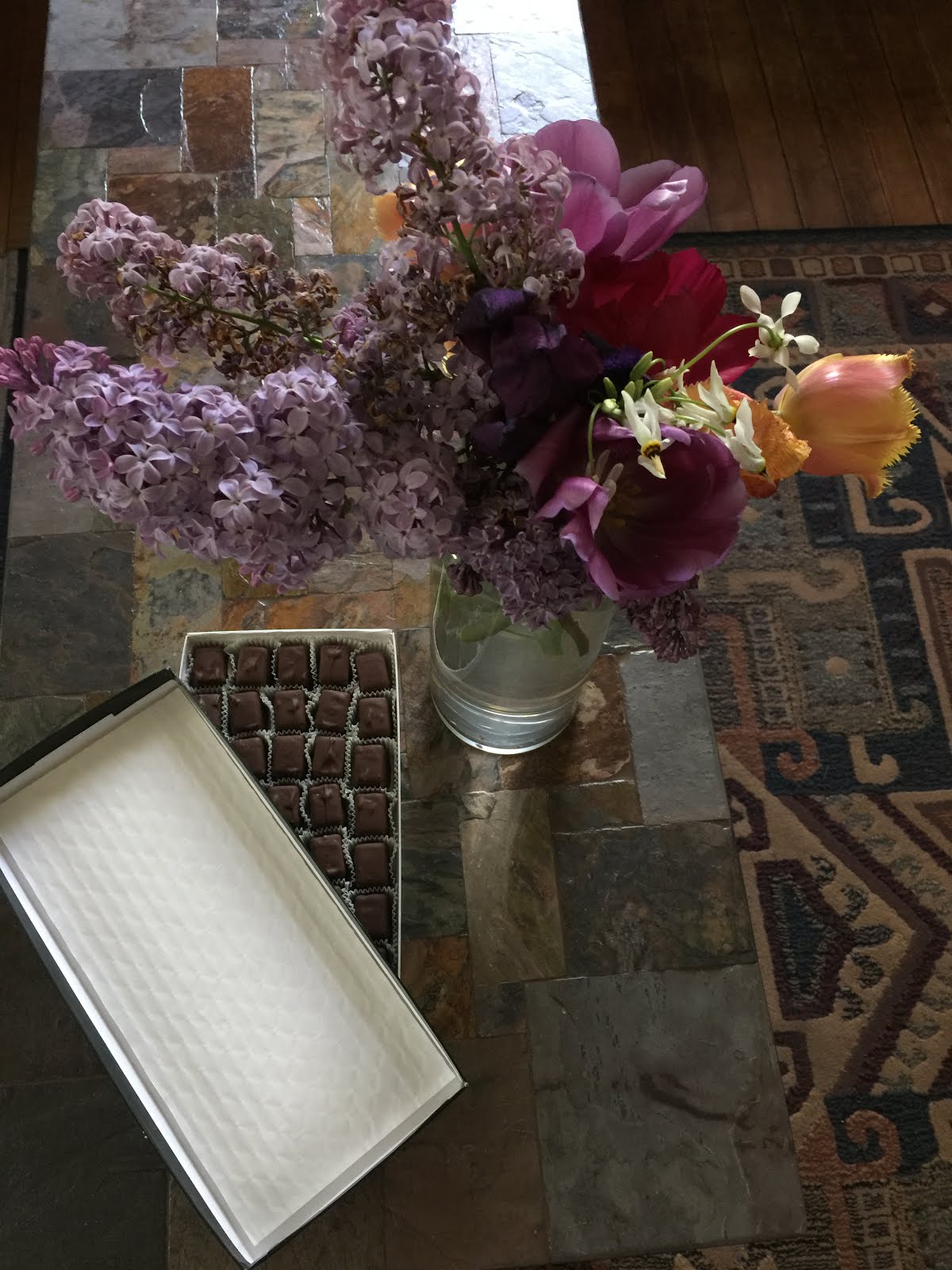
Picture, then inhale the scent, of your favorite flavor. Better even than lilacs, right? Chocolate offers poetry for the tastebuds, antidote for sadness, compensation for anxiety or stress. It’s also a reminder to everyone, including novelists, that enough is enough. 


Take details. Consider the many, many paragraphs of your novel that aren’t drama, action, or dialogue.  These fall into two general categories. 

Some narrative is immediately and directly integrated with the plot, thus creating or sustaining tension. Examples? Backstory, foreshadowing, some kinds of setting, or revelations of resources characters possess or lack. Description intrinsically linked to plot often zips along.

But a lot of the detail in novels has nothing to do with plot. Imagery and information often defeat tension. Still, novels would be mighty thin without description, symbolism, character nuance, and topics from art through zebras. 

Narrative, plot-oriented or otherwise, always affects pace, though the first  category far less than the second. That’s where chocolate comes in. First it fills your mouth with something besides your fingernails while you decide how much you need for clarity, reader satisfaction, and agent attraction. Chocolate soothes during the painful acceptance that you’re not a mindreader. Also, it warns that even something glorious can overwhelm, even nauseate, if over-indulged.  

You might consider all those add-ons that make fiction worth reading—and writing—as the sweet tang of chocolate: fantastic in moderation, but unappealing in smothering doses.

Tip: Too much, even of something quite wonderful, remains—too much.

Subtlety is key. According to Jerome Stern:
Serious writers, including comic writers, are interested in subtlety, in avoiding heavy-handed effects and obvious characterizations. They want to make readers pay close attention, and readers enjoy picking up on clues as subtle as a hesitation or a dropped glance.
Readers expect novels to order chaos, but not to remove every doubt. Readers want lots of chocolate, but not as the main course. These questions might help.
  • Do you leave space for reader imagination?
  • Do you overstate rather than imply?
  • Unsure whether readers “get it,” do you repeat once more, just to be sure?
  • Do you explain your metaphors?
  • Do your adverbs (“lazily,” crazily,” “dazedly”) “tell” what the dialogue already “shows”?
  • Do you ever overwhelm your plot with description or fact?
  • Do you write as if you have faith in reader ability to infer?
Thomas Mann observed that
Subtlety is the mark of confidence… A writer who is confident need not prove anything, need not try to grab attention with spates of stylism or hyperbole or melodrama… He will often leave things unsaid, may even employ a bit of confusion, and often allow you to come to your own conclusions.
In other words, enough chocolate to satisfy (which could be a lot!), but not to overwhelm.

Sunday, April 7, 2013

Look at Me!!!!!!

A friend asked me to look over her realtor’s listing of her house. The EXCITING copy I read offered exclamation point after exclamation point! New listing! Priced to sell! Cute! Quaint! Comfy! Just what you’re looking for!

Perhaps. But I’d rather be shown the reasons why it’s just what I’m looking for. Specify that, and you can omit all the in-your-face manipulation, which won’t convince me, anyhow. Exclamation points, caps, and even some instances of italics are like SHOUTING IN THE READER’S FACE! And, as the always understated F. Scott Fitzgerald put it, “An exclamation mark is like laughing at your own joke.” How funny can that be?

Exclamation points are symptomatic of a larger problem. How much do you trust your reader? How much do you trust your own words? If you mistakenly believe you feel that trust, or hope that grinding your teeth hard enough will make it so, all is lost! You’ll state. You’ll tell. You’ll bludgeon. You’ll smear your scenes with abstractions.

Don’t reduce emotion to vague abstractions like “anguish,” “terror,” or “ardor.”
Don’t tell us what to think. You won’t convince us, just annoy us.
Don’t think that describing character emotions helps readers feel them. That’s just another way of saying “Quaint! Comfy! Just what you’re looking for!”

Do imply. The best clues are the ones readers just barely absorb.
Do offer imagery. If we can see, hear, taste, smell, or touch it, that’s when readers experience the scene right along with the characters.
Do understate. The more tragic and dramatic the emotion, then the more quietly you should whisper when conveying it.

If you don’t trust your readers and your novel, the best way to address that is to revise until you feel good about what you’ve written. Real evidence on the page helps you relinquish control to offer readers the inference they prefer. Yes, this involves the risk that they might miss something you long to share.  But it’s always better not to make your point than to pummel readers with it.

Tip: Unless there’s a fire (!) or someone needs help (!), not a bad idea to pretend that exclamation points and other intrusive gimmicks don’t even exist.