Showing posts with label understatement. Show all posts

Sunday, November 26, 2017

“B” Is for “Bling, But…”


     -- Diamonds from the Victoria and Albert Musuem


   -- Dark Amethyst

“Bling” went mainstream in 1999, with B.G’s rap song "Bling Bling.” As the term’s popularity swelled, its meanings diverged. On one hand, the term suggests glittering enticement, the thrill of light on water, sun on glass, or anything eye-catching and memorable, such as jewels and diamonds. 
But jewels and diamonds also engender devastation and death. That’s part of the “but,” as are  gentler but still offensive connotations, like garish gaudy, shallow, and tasteless. 

Considering that crude splashiness, why not just leave bling to those wearing glitter teeshirts or cheap jewelry? Or, to those who, like Edith Wharton’s nouveau riche, substitute ostentatious decor for class? 

But wait a second. Fear of bad bling, or bling without the self-censoring “but,” often inhibits style, resulting in flat prose and atonal sentences. The very concept underlying bling is flash, energy, and enthusiasm. Vitality. 

The term “bling” metaphorically combines the senses, as in the imagined sound of light striking a jewel, or a combination of “ring” and “bright.” You want to conjure strong sensations, to provide electricity, originality, and magnetism. Isn’t that the difference between “good” writing and “great”? None of that comes from playing it safe.

Unfortunately, though, there’s no bling barometer to reveal whether we’ve provided one form of bling or the other. Practice, accompanied by sound feedback, develops a sense of what’s sparkly fun and what’s offensive overstatement.

Want to experiment? Try for these.

~ Shock:
But the next day he returned to the basement to determine if he'd seen what he'd seen, and that night at dinner, ordinarily a somber affair during which his father related his business woes to an indifferent wife, Bernie muttered, “There's an old man in the meat freezer.”— Steve Stern, The Frozen Rabbi 
~ Syntactical Rhythm:
Eddie had come to understand that what a man saw and what actually existed int he natural world often were contradictory. The human eye was not capable of true sight, for it was constrained by its own humanness, clouded by regret, and opinion, and faith.― Alice Hoffman, The Museum of Extraordinary Things
~ Sound Combinations:
The forty days of the soul begin on the morning after death. That first night, before its forty days begin, the soul lies still against sweated-on pillows and watches the living fold the hands and close the eyes, choke the room with smoke and silence to keep the new soul from the doors and the windows and the cracks in the floor so that it does not run out of the house like a river.—Tea Obrecht, The Tiger’s Wife
Tip: “Bling” makes fiction sparkle, but only with moderation, understatement, and good taste.

Sunday, September 17, 2017

The Secret Spaces inside the Scene

Fiction requires vividness, suspense, and empathy. But do you leave readers enough room for an intimate experience of detail, tension, and emotion?

As Charles Baxter puts it, 
A novel is not a summary of its plot but a collection of instances, of luminous specific details that take us in the direction of the unsaid and unseen.
That’s subtext, which, according to A.J. Humpage, 
is the implied meaning or theme within the narrative. It can also refer to the thoughts, actions and motives of characters that are not always so overt.
If everything is “overt,” from the character’s loneliness to the cold moss where she rests her tear-stained cheek on a fallen tree in the Southeast corner of the Olympic National forest, then perhaps ironically, fiction becomes drab, tepid, and dispassionate. 

Tip: Spell everything out, and you deprive readers of the chance to participate.

In Wired for Story: The Writer's Guide to Using Brain Science to Hook Readers from the Very First Sentence, Lisa Cron observes that:
When you put together large numbers of pieces and parts, the whole can become something larger than the sum.…The concept of emergent properties means that something new can be introduced that is not inherent in any of the parts.
What’s this new entity? In the best novels, it’s the synthesis of every aspect of fiction: plot makes detail more vivid, context builds characterization, and description intensifies suspense. But there’s more. That’s your readers feeling, wondering, interpreting, and analyzing. Until “The End,” those responses change frequently. And if the writer succeeds, many of those conclusions will prove irrelevant or inaccurate. Do you want surprised readers? Give them some freedom.

When readers can infer, fiction imitates life. There’s no circumstance where we reliably have all the information. So if fiction leaves nothing to the imagination, a novel is not only overloaded and oversimplified, but unrealistic. 

How can you encourage reader participation?

~ Subtext in dialogue.

      People rarely say exactly what they mean. Your characters shouldn’t, either.

~ Metaphor.

     When symbolism works, it replaces setting dense enough to overwhelm plot.

~ Emotional overload.

      Provide clues that let readers experience what the characters do.

~ Focus.

     If your goal is intense drama or suspense, don’t let anything compete with that.


Instead of walling readers out with excessive description and explanation, let readers take the journey along with your characters—instead of getting it secondhand.

Thursday, June 22, 2017

“Anguish” or “pain”? “Yearning” or “Desire”?

The difference? Less is more. For novelists, that notion never gets old, because most of us want more words, more syllables in those words, and more melodrama everywhere. And why not?

Because, Brendan Kenny puts it, 
Hyperbole and overstatement do more harm than good. Hyperbole is exaggeration. Overstatement is an attempt to convince your audience by bludgeoning them with facts, arguments, and pleas to get them to accept your assertion.
And this is as true for fiction as for law. In an interview with Roxane Gay, Joshua Henkin agrees:
I tend to gravitate toward understatement. My novels and stories are animated as much by what’s not said as by what’s said. It’s the silences in fiction (and in life) that, if rendered well, can be most illuminating.
Tip: The source of emotional engagement is putting readers in the moment instead of pushing them there.

Inflated or cliched language and description never involve readers the way these passages do:
My mother always says that fear and pain are immediate and that, when they’re gone, we’re left with the concept, but not the true memory—why else, she reasons, would anyone give birth more than once? I think I understand what she means when I look back on the night of the fire. Part of me knows that there was tremendous pain, that the heat of the blaze as it came down though the old village on the hill and Slavko’s farmland and our orange grove and ripped through the fig and almond trees, the pinecones sizzling like embers for what seemed like forever before they exploded, was unbearable; that to say that it was difficult to breathe is an impossible understatement; that the hair on my bare arms was already singed when the fire dropped down through the pines and rushed the brick wall. —Tea Obreht The Tiger’s Wife
You’re right there with the girl trying to beat back the fire. This connection happens because of the opening metaphor, the particularity of the details, the reflection after the fact, and the acute physical sensations. An understated portrayal of tragedy.

Understatement works equally well for joy. In Daisy Goodwin’s Victoria, the Queen Victoria’s new status terminates what could’ve been a budding romance, and she tells her prime minister:
“I was so happy … before.’”     “I find that happiness can always be recollected in tranquillity, Ma’am,” said Melbourne.      Victoria put her hands down and looked up at him, her pale blue eyes searching his face. “You were happy too?”     When Melbourne spoke, it was in the voice not of the urbane Prime Minister, but of a man of advancing years who is facing the loss of the only thing that is still capable of bringing him joy. “You know I was, Ma’am.” 
The Lord’s unadorned admission conveys everything Victoria needs to know, and through her, to those experiencing the scene vicariously. 

Shout, and you might get ignored. Whisper, and everyone will lean in to overhear. 

Sunday, May 14, 2017

Chocolate and the Novelist

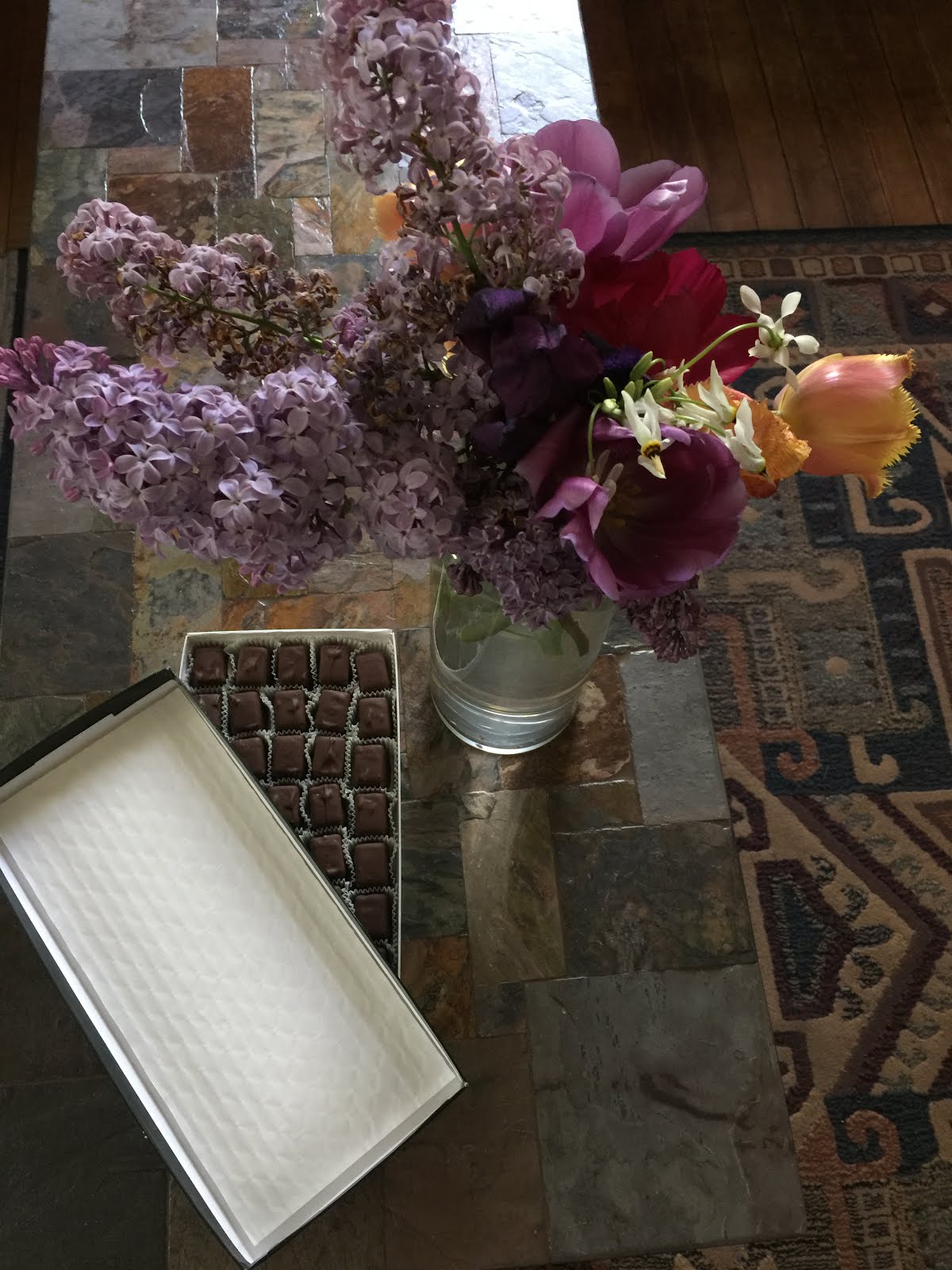
Picture, then inhale the scent, of your favorite flavor. Better even than lilacs, right? Chocolate offers poetry for the tastebuds, antidote for sadness, compensation for anxiety or stress. It’s also a reminder to everyone, including novelists, that enough is enough. 


Take details. Consider the many, many paragraphs of your novel that aren’t drama, action, or dialogue.  These fall into two general categories. 

Some narrative is immediately and directly integrated with the plot, thus creating or sustaining tension. Examples? Backstory, foreshadowing, some kinds of setting, or revelations of resources characters possess or lack. Description intrinsically linked to plot often zips along.

But a lot of the detail in novels has nothing to do with plot. Imagery and information often defeat tension. Still, novels would be mighty thin without description, symbolism, character nuance, and topics from art through zebras. 

Narrative, plot-oriented or otherwise, always affects pace, though the first  category far less than the second. That’s where chocolate comes in. First it fills your mouth with something besides your fingernails while you decide how much you need for clarity, reader satisfaction, and agent attraction. Chocolate soothes during the painful acceptance that you’re not a mindreader. Also, it warns that even something glorious can overwhelm, even nauseate, if over-indulged.  

You might consider all those add-ons that make fiction worth reading—and writing—as the sweet tang of chocolate: fantastic in moderation, but unappealing in smothering doses.

Tip: Too much, even of something quite wonderful, remains—too much.

Subtlety is key. According to Jerome Stern:
Serious writers, including comic writers, are interested in subtlety, in avoiding heavy-handed effects and obvious characterizations. They want to make readers pay close attention, and readers enjoy picking up on clues as subtle as a hesitation or a dropped glance.
Readers expect novels to order chaos, but not to remove every doubt. Readers want lots of chocolate, but not as the main course. These questions might help.
  • Do you leave space for reader imagination?
  • Do you overstate rather than imply?
  • Unsure whether readers “get it,” do you repeat once more, just to be sure?
  • Do you explain your metaphors?
  • Do your adverbs (“lazily,” crazily,” “dazedly”) “tell” what the dialogue already “shows”?
  • Do you ever overwhelm your plot with description or fact?
  • Do you write as if you have faith in reader ability to infer?
Thomas Mann observed that
Subtlety is the mark of confidence… A writer who is confident need not prove anything, need not try to grab attention with spates of stylism or hyperbole or melodrama… He will often leave things unsaid, may even employ a bit of confusion, and often allow you to come to your own conclusions.
In other words, enough chocolate to satisfy (which could be a lot!), but not to overwhelm.

Sunday, October 23, 2016

Hush, or Understatement, Subtext, and Whispering

Let’s start with a picture. After all, aren’t novels one picture after another of characters—both inside and out?


What do you see? This Bernini sculpture, which you can view in Rome’s elaborately decorated Santa Maria della Vittoria Church, has a story behind it.

The title, “The Ecstasy of St. Teresa,” clarifies that it’s a male angel, and that his hand, yes, indeed, is exactly where we suspected but were reluctant to admit. Is the angel really doing that? Yes.

Here’s a closer look. 


What captures the ecstasy? The Saint’s flung-back head, the arched body, the open mouth, the foot bodiless enough to seem devoid of bones. The sculpture melds earth and heaven—keen awareness of body with the ultimate transcendence of it. The sculpture conveys all this with such subtlety that without the tantalizing suggestion, much of this might go unnoticed. What a terrific recipe for fiction.

Tip: The more readers discover emotion, rather than being bludgeoned with it, the happier they'll be.

How does that work?

~ Understatement.

Intense emotion, such as tragedy, disaster, euphoria, or ecstasy needs implication. Because readers already know how they feel about such events. The more you “tell” them then, particularly with judgments like “horrible,” “painful,” “terrifying,” or joyous,” then the less readers can feel what they already do without your help. Abstract words, especially over-used ones, separate readers from plot, much the way adding the word “rapturous” to Bernini’s title would only interfere. Just as he uses the subtle folds of the marble—and what that implies—to make his point, use the events—not the descriptions—in your novel to make yours.

~ Subtext.

Literally what’s “beneath the words,” subtext involves what characters say indirectly.  A wife reluctant to confront her husband overtly might observe, “You needed another fishing rod?” A father might freak at his daughter’s low-cut, skin-tight tank top, and mutter, “Is that all you’re wearing? “Meaning implied but never vocalized both mimics real-life interaction and leaves readers free to interpret. This resembles the way one can scrutinize Bernini’s sculpture and infer the feelings of the angel and the saint.

~ Whispering.

With rare exceptions, the more intense the emotion, then the more subtly and quietly you ought to describe it. Defy this rule of both craft and psychology, and the likely result is melodrama, or a portrayal that feels sensational rather than emotionally gripping. Neither reader nor writer wants a novel to read like a tabloid.

How do you whisper? 
  • Use concrete language that evokes one of the five senses: sight, sound, taste, touch, or smell.
  • Avoid judgmental conclusions like “anguished,” “devastated,” or “heart-stopping.”
  • Focus more on what happens than how scary or wonderful or terrific it is.

Here’s the ultimate understatement: trust your audience. Bernini did.

Sunday, July 24, 2016

Alliteration on the Side, Please

Few of us are entirely immune to gorgeous, partially-clad people; tear-jerking movies; Viennese pastries or waltzes; or even a gob of imported, cream-laden blue cheese dressing. Overdone, though, delicious becomes cloying, because too much is…too much.

Amplified amounts of awe-inspiring alliteration almost always aggravate more than amaze. After all, the easy way out defeats plot captivating because of causality, characters haunting because of depth, sentences noteworthy because of rhythm, and wording harmonious because echo replaces repetition.

Whatever calls too much attention to itself in prose, even in poetry, fills the space that readers should inhabit. No one likes being patronized. Understate, and readers can participate. Avoid these alternative forms of “telling:

~ Italics.
           
Consider reserving them for constructions like x’s and o’s or foreign phrases like oy gevalt. Avoid italics for emphasis. Instead?  “Show” your readers how to read it. Better still? Let them decide for themselves.

~ Exclamation points!!!

No!!!!! Please!!! These distract even more painfully than alliteration or italics!!! See what I mean? Again, as they tell the kids, use your words.

~ One-sentence paragraphs.

            Every so often?

            Fine.

            Over and over?

            No dice.

Such paragraphs hint that you’re shouting or filling space. And if so many single lines are so important, maybe you should rethink something?

~ One-dimensional emotions.

Few emotions actually are. Guilt and anxiety often tinge lust. Sadness can sneak into the loveliest happiness. Limit the number of straightforward, oversimplified, abstractions like “good,” “sad,” “triumphant,” “frustrated.” These, too, distract.

You might quickly surprise yourself by how little you miss obvious devices once you stop relying on them.

Tip: Reserve cute for rabbits, kittens, and the dimpled knees of newborns.

Sunday, May 22, 2016

Dealing with the Devil in those Details

For novelists and everyone else, detail sometimes involves a trick, curve, mystery or problem that’s invisible until—it’s too late. The phrase evolved from “God is in the detail,” and the author of triumphant details certainly achieves a succinct universality unavailable to mere mortals.

Since details are the stuff that novels are made of, how does the devil infiltrate?

~ Tedium.
   
The less new you can make it, then the faster you should say it.

~ Melodrama.

If someone’s dying or a country’s being raped, resist the temptation to explain that this is horrible. Let vivid, understated details convey the point for you.

~ Repetition.

            Why say it specifically, then generally? Or the other way around.  This inadvertent habit
            insinuates condescension. In other words, it presumes that readers can’t figure it out
            without a few versions. So don’t patronize. Even accidentally. Even if you certainly never
            intended ill will. Or insulting your readers is the last thing you want. See how annoying it
            becomes in no time at all?

~ Self-indulgence.

With rare exceptions, detail enhances story only when it enriches character and/or plot. Make the setting reveal character and heighten tension.

~ Uniformity.

            Don’t keep piling up similar details. No matter how vituperative the villain or angelic the
infant or pure the snow, provide nuance and dimensionality.

~ Significance

“Literature differs from life in that life is amorphously full of detail, and rarely directs us toward it, whereas literature teaches us to notice. Literature makes us better noticers of life; we get to practice on life itself; which in turn makes us better readers of detail in literature; which in turn makes us better readers of life” (James Wood). Emphasize the details you want readers to notice. This sounds silly! But it’s easy to distract yourself with the vividness of an image or sound of a sentence and lose track of what matters about this scene.

~ Approximation.

“The truth of the story lies in the details” (Paul Auster). You annoy readers by
confusing the location of Times Square or crucial dates of  WWII. You also annoy
readers by trampling psychological and moral truth in the characters you create.

~ Fogginess.

“Nothing is less real than realism,” Georgia O'Keeffe observed. “Details are confusing. It is only by selection, by elimination, by emphasis, that we get at the real meaning of things.”  No matter how autobiographical your fiction, choose details to reveal pattern and cement credibility. Offer the focus that reality cannot.

Tip: If the detail isn’t adding, it’s subtracting.

Sunday, January 10, 2016

OVERWROUGHT!!!!!!!

“Overwrought.” Since its first meaning is over-stimulated to the point of hysteria, we associate this word more with behavior than language. Yet “overwrought” also defines purple prose— phrasing that’s ostentatious, gaudy, pompous, self-conscious, self-indulgent, and likely to drive readers nuts.

Tip: Overblown language isn’t lively or original; it’s excessive and irritating.

To illustrate, I could choose from hundreds of classical or contemporary disasters. Instead, I tactfully offer hyperbole of my own making:

The few faint, final, fluttery wand-like wisps of the dying sun’s peach, mauve, and magenta rays whispered past the stony-faced mountains, majestic mountains unmoved by the sky’s pyrotechnics as it sank, ever more slowly, toward its well-deserved rest. The scene’s serenity reminded the still-heartbroken widow of all she had lost. Never again would she savor his tender caress, his musical laughter, his powerful arms. No! The love they’d had was lost forever. No, no, no! As the thickening twilight besieged her, no one anywhere in the world yearned with greater anguish, or wept with more acrid acerbity.

Let’s examine “overwrought,” one issue at a time.

~ Lighten up on colors, especially esoteric ones like peach, mauve, or magenta.

~Exercise caution with the familiar, including the heavy-handed symbolism of the setting sun.
There’s a reason “It was a dark and stormy night” is more hilarious than threatening.

~ Avoid personification, or attributing human characteristics to anything inhuman.
Does the sunset actually “whisper”? Are those mountains more moved by sunrise than sunset? Does the sun really need a rest? Deserve one? Can twilight “besiege”?

~ Insinuate sound echoes.
A little alliteration, or repetition of initial consonant sounds, goes a long way. Bombard
 with poetic devices, and you’ll move readers to laughter instead of tears.

~ Understate.
A widow watching the sun set already verges on melodrama. That means you can’t have clichés, exclamation points, turgid pace, vapid generalizations, or annoying repetition.

~ Eliminate arcane or abstract language.
Certain words achieve neither invisibility nor imagery. The paragraph above is full of them: “savor,” “forever,” “yearned,” and “anguish.” This language diminishes rather than intensifies the moment.

Replace oversimplified judgments like “tender caress,” “musical laughter,” and “powerful arms” with original imagery.

“A discerning eye needs only a hint, and understatement leaves the imagination free to build its own elaborations.” -- Russell Page

One concrete, apt suggestion is worth a hundred tired, redundant, overblown details.

Sunday, March 15, 2015

How Are Sherman Alexie and Steven Colbert Alike?

Wherever you are politically, you probably find the other side naively misguided or dangerously evil. You probably have at least one friend on the other side. What to do?

Tip: Laughter just might be the quickest route to compassion, healing, and insight.

Alexie and Colbert are both comedians of many trades, but comparing a pundit to a novelist feels like comparing “truthiness” to facts. Yet here they both are on conflict in America:

It’s like this white-Indian thing has gotten out of control. And the thing with the blacks and the Mexicans. Everybody blaming everybody...I don’t know what happened. I can’t explain it all. Just look around at the world. Look at this country. Things just aren’t like they used to be. – Sherman Alexie, Indian Killer

Let’s all go back to the good old days! Here’s another.

Join me in standing up against any actual knowledge about guns. Let the CDC know they can take away our ignorance when they pry it from our cold dead minds. – Stephen Colbert

Or on homophobia from a devout Catholic:

Christianity is the best way to cure gayness — just get on your knees, take a swig of wine, and accept the body of a man into your mouth. – Stephen Colbert

            and

My grandmother’s greatest gift was tolerance. Now, in the old days, Indians used to be forgiving of any kind of eccentricity. In fact, weird people were often celebrated. Epileptics were often shamans because people just assumed that God gave seizure-visions to the lucky ones. Gay people were seen as magical too. I mean, like in many cultures, men were viewed as warriors and women were viewed as caregivers. But gay people, being both male and female, were seen as both warriors and caregivers. Gay people could do anything. They were like Swiss Army knives! My grandmother had no use for all the gay bashing and homophobia in the world, especially among other Indians. “Jeez,” she said, Who cares if a man wants to marry another man? All I want to know is who’s going to pick up all the dirty socks?” – Sherman Alexie, The Absolutely True Diary of a Part-Time Indian

What’s this got to do with your fiction?

~ The angrier you are, then the more you need to understate.
~ The angrier you are, then the more you need irony.
~ The more you want people to listen, then the more you need to make them laugh. at least 
    sometimes.


Novels change us by clarifying the issues. Ranting only divides, as does oversimplifying characters into heroes or villains. As Colbert put it, “That’s why I don’t think I could ever stop doing what I’m doing, because I laugh all day long and if I didn’t I would just cry all day long….I would say laughter is the best medicine. But it’s more than that. It’s an entire regime of antibiotics and steroids.” Here’s to our health.

Sunday, May 4, 2014

The Writer, the Reader, and the Goldilocks Dilemma

Who wants context so sparse that the scene seems to occur mid-air? Who wants to read thickly layered description that resembles a bowl of lukewarm porridge vast enough to fill a T Rex belly? Every reader, writer, and lost little girl wants a meal that’s “just right.” Goldilocks sampled everything. But your goal is having so many readers that assessing their individual needs becomes impossible. How do you offer a serving neither meager nor massive?

~ Trick yourself into reading like a reader.
“Trick” is the operative word here. You find your scene perfectly clear and your sentences, um—glorious. Uh, uh. How would this read if you didn’t already know what’s at stake? Weren’t smitten with the syntax? Take a break for days, maybe weeks. Try reading aloud, printing the pages. You can teach old writers new tricks.

~Provide context.
Who wants to guess character age or gender, or where and when this takes place? If this is urban fantasy or romance? If the tone is serious or satiric? Clarify the broad picture. Let readers infer the rest from clever clues.

~ Imply.
The human mind has a remarkable capacity to use hints for completing the picture, guessing the meaning, grasping the idea. Clues are fun. Spelling everything out? Not fun. Closer, in fact, to being stuck with a boring teacher. We’ve all been there.

~ Use the five senses.
Even a little abstraction, such as “painful,” “satisfying,” or “exquisite,” feels like that giant dish of soggy cereal. Offer concrete imagery, ideally in original combinations. The first image that leaps to mind is likely to be weak and tired. Keep hunting.

~Construct great metaphors.
Then let them speak for themselves. If they’re really that great, you needn’t explain them.

~Avoid double-dipping.
Readers rarely want to hear that Ed sneered and glowered, or that Nancy laughed with joy and amusement, or that Eloise slouched and trudged. Find the right image or explanation so you won’t be tempted to torture with two.

~ Understate.
The more intense the emotion or catastrophe, then the less you need to say about it.


Sometimes, of course, like Goldilocks, you may have to assess the scene with the detail in or out, the sentence reduced or expanded. Experiment, and you’ll get better and better at “just right.” After all, you’re lots more sophisticated than little Goldilocks.

 Tip: Readers need “facts” in order to draw conclusions about what those “facts’ mean.

Sunday, October 13, 2013

Please don’t shout!

Readers “hear” perfectly well and dislike what amounts to fiction that hollers: Bold, CAPS, italics, underlining, delineating, explaining what the scene will or did express.

Tip: Shouting is patronizing. Who appreciates patronizing?

And yet it’s rampant. Insecurity plays a major role. Consciously or not, many writers think, “I don’t write well enough to make my point, so I’ll just clarify. And in case someone reads extremely quickly, I’ll just clarify again. And slip in a bit of special formatting. How can that hurt?”

It can. Lots. Lower your voice, please. Did you ever notice how many people raise their voices with children, dogs, and English-as-a-Second-Language speakers? However inadvertent, even well-meaning, yelling comes across as insult. Its source is a different kind of mistrust—not of self but audience. Maybe they’re too young, too almost-American, or too downright canine. Yet people resent this, and perhaps even dogs feel the same way. If they don’t understand about asking to go out when they need to, yelling won’t clarify. This applies to readers, as well. Yelling isn’t more clear—just more annoying.

But don’t throw up your hands in despair or join Screechers Anonymous. A few super-serious questions might help.

~ Do you value your theme more than your plot?
That could make anyone scream, so evaluate your priorities.
~ Are you writing literary or mainstream?
Such readers are particularly quick to sniff out condescension.
~ Are you applying the speech formula to your novel?
Fiction gives you one shot, not hinting the point, making it, and then reviewing.
~ Does your scene require special effects for clarity and intensity?
If so, revise your scene. Use your words.
~ Aren’t italics or bold legitimate in some instances?
            Of course, but you’ll do better pretending no such instances exist.
~ Have you revised enough to feel good about your manuscript?
Then let it speak for itself. Please.

If you’ve ever stood in a bookstore or used book sale checking novel after novel to see which ones you want, consider why you put some back. Though cloaked in many disguises, the issue is often “Too condescending—and I get enough of that at work.”


Whispering, insinuating, suggesting, demonstrating all beat bellowing. Every time. Bury the megaphone. Unclip the microphone. Try whispering. Is there really a better way to make people lean in and listen?

Sunday, April 7, 2013

Look at Me!!!!!!

A friend asked me to look over her realtor’s listing of her house. The EXCITING copy I read offered exclamation point after exclamation point! New listing! Priced to sell! Cute! Quaint! Comfy! Just what you’re looking for!

Perhaps. But I’d rather be shown the reasons why it’s just what I’m looking for. Specify that, and you can omit all the in-your-face manipulation, which won’t convince me, anyhow. Exclamation points, caps, and even some instances of italics are like SHOUTING IN THE READER’S FACE! And, as the always understated F. Scott Fitzgerald put it, “An exclamation mark is like laughing at your own joke.” How funny can that be?

Exclamation points are symptomatic of a larger problem. How much do you trust your reader? How much do you trust your own words? If you mistakenly believe you feel that trust, or hope that grinding your teeth hard enough will make it so, all is lost! You’ll state. You’ll tell. You’ll bludgeon. You’ll smear your scenes with abstractions.

Don’t reduce emotion to vague abstractions like “anguish,” “terror,” or “ardor.”
Don’t tell us what to think. You won’t convince us, just annoy us.
Don’t think that describing character emotions helps readers feel them. That’s just another way of saying “Quaint! Comfy! Just what you’re looking for!”

Do imply. The best clues are the ones readers just barely absorb.
Do offer imagery. If we can see, hear, taste, smell, or touch it, that’s when readers experience the scene right along with the characters.
Do understate. The more tragic and dramatic the emotion, then the more quietly you should whisper when conveying it.

If you don’t trust your readers and your novel, the best way to address that is to revise until you feel good about what you’ve written. Real evidence on the page helps you relinquish control to offer readers the inference they prefer. Yes, this involves the risk that they might miss something you long to share.  But it’s always better not to make your point than to pummel readers with it.

Tip: Unless there’s a fire (!) or someone needs help (!), not a bad idea to pretend that exclamation points and other intrusive gimmicks don’t even exist.