Showing posts with label characterization. Show all posts

Sunday, February 11, 2018

Hard-wired for Story

The organic world is mostly phototropic. Like plants and moths, people gravitate toward the light. In fact, the longing to stare at the sun can risk sunburned eyeballs, even damaged retinas. 


Without the deleterious side effects, storytelling has always wielded similar magnetism.

 Since humans have been humans, they’ve told stories. That’s because
According to Uri Hasson from Princeton, a story is the only way to activate parts in the brain so that a listener turns the story into their own idea and experience. — Leo Widrich,“The Science of Storytelling: Why Telling a Story is the Most Powerful Way to Activate Our Brains”
You’re a novelist in a world crowded with obligations and distractions competing for attention. When children—and grownups—beg “Tell me a story,” they want to hear a great one. How can the storytelling instinct help you attract readers and keep them engaged?

~ Tension.

It’s no accident that any writing coach will insist that it’s needed on every page. Interrupt the story, and you interrupt reader connection with it. That connection, of course, is why readers care about characters and why fiction has always been a means for cultural instruction: 
in order to motivate a desire to help others, a story must first sustain attention–-a scarce resource in the brain–-by developing tension during the narrative. If the story is able to create that tension then it is likely that attentive viewers/listeners will come to share the emotions of the characters in it, and after it ends, likely to continue mimicking the feelings and behaviors of those characters — Paul J. Zak, “Why Your Brain Loves Good Storytelling”
~ Causality

Unless each—each rather than some or most!—event in the novel determines what follows, the novelist offers the randomness of life rather than the meticulously shaped progression of story.
A story, if broken down into the simplest form, is a connection of cause and effect. And that is exactly how we think. — Leo Widrich
~ Universality

Different cultures certainly express human emotions differently. But the emotions themselves remain constant. That’s why stories let people vicariously bleed under the lash of slavery, recoil at the stench of a dragon’s breath, shiver in the trenches of a battlefield, or bask in the awe of a kiss from the spouse you’ve loved for fifty years.


Tip: The greatest stories spring from capitalizing on the human instinct for narrative.

Sunday, January 7, 2018

More Real than Reality

Story depends on suspension of disbelief, which depends on creating a world that ironically boasts greater credibility and vitality than the everyday one. What’s the source of this term? A conversation between William Wordsworth and Samuel Taylor Coleridge about reaching an audience. 

Wordsworth focused on the intensity part, suggesting that the writer’s task is  
to give the charm of novelty to things of every day . . . the loveliness and the wonders of the world before us; an inexhaustible treasure, but for which, in consequence of the film of familiarity and selfish solicitude we have eyes, yet see not, ears that hear not, and hearts that neither feel nor understand.
Altering reader perception remains as important now as then. Coleridge, though. emphasized the capacity
to transfer from our inward nature a human interest and a semblance of truth sufficient to procure for these shadows of imagination that willing suspension of disbelief for the moment, which constitutes poetic faith. . .
Without believability + electricity, readers won’t linger long. The novelist needs to heighten reality, producing one so acute that readers forget they encounter an imaginary one.

Is getting readers to accept this fictional reality difficult?
The reader picks up a book primed to believe the unbelievable. A reader knows a piece of fiction is fiction. He wants to be entertained by what-ifs and imagine-thats. The writer’s sole task, then, is to keep up his end of the contract, to keep the reader immersed in the reality of unreality. To do nothing to slap the reader into an awareness that what he’s reading is indeed impossible, improbable, and not worth imagining.  — Beth Hill,  “Convincing Readers Your Fiction is Real”
Tip: Unlike literal reality, fiction requires suspension of disbelief. 

Here’s why. Perhaps an author says there’s an animal resembling a miniature version of another animal. This creature is pale, not very big, and unusual in shape and features. The male gets pregnant and experiences violent contractions to deliver about two thousand offspring through a special stomach pouch. Does this seem a bit unreal? Provide a photograph and there’s no room for doubt.


But a fabricated creature is another story—especially when it appears in one. First, the creation of your own mind must be accessible to everyone else. You must convince your audience that the environmental factors of your novel’s world fostered this evolutionary outcome. Finally, this invented creature mustn’t prove too convenient, i.e. coincidentally materializing to produce threat or salvation. 

Fiction must prove itself, accomplishing this by changing the angle, nailing the details, designing the characters, and sharpening the causality. That’s why “but it happened that way” is no more strategic than why can’t they picture how “x” looks. Imagery is the writer’s job—not the reader’s.

Rely too much on reality itself (whom you know or what you remember) and you’ll have a harder time convincing readers to accept the reality you create. Instead, put yourself in your reader’s shoes. Is it vivid? Was it set up? What, given these circumstances, could really happen?


Readers want to accept fiction as a variant of truth. Don’t let them down.

Sunday, September 10, 2017

The Shopping Cart and the Novelist

Consider this random grocery list, left behind at a supermarket.

Anything strike you?

That’s what this blog’s about. Not a suggestion that if you can’t fix a passage or find a publisher, stock up on butter pecan ice cream, toffee peanuts, chocolate syrup, and marshmallow fluff for topping. Nor will the following suggest how to build a character from a mash-up of income, hair color, education, favorite TV show, and place of birth. Instead, here’s the deal.

Tip: The wonderfully unexpected is available everywhere; you only need to notice.

And that’s mostly a matter of habit. Because finding pattern in chaos approximates the age of humanity itself. Things have changed, though:  
Surprise, the unknown, is all around us, but due to the way human beings live now, our lives are built to streamline through, to desperately try and cut through surprise, mystery, or ignorance. All the information in the world is available from a computer screen. — J.P. Shiel, “The Element of Surprise: A Storyteller’s Secret Weapon”
For creators in any field, including fiction, the price paid for that instantaneous knowledge is high. We’re no longer continually on the hunt for the observations to protect our families, no longer sifting and sifting to recall a particular fact. It’s easier just to look it up, and that includes storm watches and warnings.

This means it’s harder for the cook or woodworker or novelist to surprise herself. That’s not good, because as Jane K. Cleland puts it, “The best surprises add significant insights to the characters involved in that surprise, while setting up future suspenseful situations.” It’s why people don’t want to know the ending of the book or movie in advance. Surprise is fun.

Now what’s this got to do wth shopping carts? Scrutinizing details is among the many potential strategies for perceiving pattern and producing surprise. For example, what can you infer from the list above?

     Lots of brand names

     Both fancy tortellini and pedestrian hamburger

     Few carbs

     No desserts

If you wanted to, couldn’t you use this list to build a profile, shape a character, compose a backstory? You probably don’t want to, because that’s unlikely to improve your novel. Here’s what will, though:

~ Notice everything around you. Seek the unfamiliar in the familiar.

~ Recognize “found art.” Ruminate on its meaning.

~ Check for patterns in the apparently random. This might take practice.

~ Look for potential organization in what seems totally chaotic.

~ Train yourself to brainstorm without censorship. Inhibition thwarts creativity.


Next time you find someone else’s list, imagine the story behind it. This will open you to a more insightful and original version of that story you really want to tell.

Sunday, July 23, 2017

Writer “R” and “R” and “R”

Pushing yourself to meet deadlines, achieve goals, and revise deeply—all great. Rejuvenating every so often is not only equally great, but crucial. So here are some “r’s” to balance not only writing, but the writing life.

~ Replenishment.

How can you create if you’ve exhausted the supply of words, ideas, story questions, metaphors, and revision techniques? Maybe you need a vacation. Or a staycation.  Or a rigorous workout, a hilarious movie, a fancy dinner.  No two novelists will need exactly the same thing or amount of it. But when you genuinely need a break, take one. Minus the guilt.


~ Remembrance. 

As Dean Koontz reminds,
Have fun, entertain yourself with your work, make yourself laugh and cry with your own stories, make yourself shiver in suspense along with your characters. If you can do that, then you will most likely find a large audience; but even if a large audience is never found, you'll have a happy life.
When did you last remind yourself what drives you to write your novel?

~Rhythm.

Obviously, you want rhythm between dialogue and narrative, scene and summary, snappy and leisurely sentences. Don’t you also need a rhythm in your writing time? Sometimes a super-short session on one day might produce a far magnificently productive one the next. In contrast with flexible goals, rationalization, of course, is the writer’s enemy.

~ Reality.

As A. Lee Martinez put it, “Those who write are writers. Those who wait are waiters.” External and internal circumstances will never cease rollercoasting, so protect momentum when it hits. For the rest of time, if necessary, create a schedule. Then respect it.

~Resolution.

Neil Gaiman admits that “All writers have this vague hope that the elves will come in the night and finish any stories.” If that hasn't worked for him, it’s unlikely to work for the rest of us. This doesn’t mean that a litany of “should’s” “should” immobilize you. Or you “should” descend to guilt equivalent to consuming an entire carton of gelato. Resolve not to squander the exquisite energy fired by your scenario, or characters, or the stimulation of crafting words. Remind yourself why you’re writing.


Tip: The act of completing a novel requires as much balance as the art of writing one.

Saturday, July 15, 2017

A Harsh Numbness Descended to My Entrails, Writhing There

Whoops! A harsh numbness as opposed to a cheerful one? The numbness actually descended, writhed later? Is it strategic to discuss emotion (or lack of it) in terms of entrails?

Here’s why not. Ever start watching an old movie only to become dismayed by the music? The melodramatic facial expressions? A plot so obvious it seems a sixth grader contrived it? Although you’re dying to know who Tony Curtis was or how the young Tommy Lee Jones looked (blond and great!), you give up. No novelist wants readers doing that.

Tip: Tastes change.

Obvious as that seems, what you learned to read in what my folks called “their youth” (see how language changes?), that’s unlikely to be what you want to write right now.

So what’s different?

~ Concept.

It may have been true since Ecclesiastes that “there is no new thing under the sun,” but as Donald Maass puts it in Writing the Breakout Novel:
What about your premise? Is it truly a fresh look at your subject, a perspective that no one else but you can bring to it? Is it the opposite of what we expect or a mix of elements such as we’ve never seen before? If not, you have some work to do.
It’s a bittersweet irony that readers enjoy familiarity—but never too much of it.

~ Characterization.

Readers loved Dickens not despite the unctuousness of a creep like Uriah Heep or unmitigated greed of Ebenezer Scrooge, but precisely because the good and bad guys were unquestionably identified. Now, though, every bad guy is in some way good, and every good gal overcome by fatal flaw. In pretty much every book, today’s characters are full-bodied, passionate and resilient, but usually wrong-headed in at least one way.

~ Plot.

A great divide exists between those arguing that literary fiction is never about plot, while genre fiction is never about anything else. But writing coaches like Lisa Cron or Jessica Page Morrell, not to mention agents, publishers, and readers themselves, like to see high stakes. Unlike the meandering beauty of the 19th century novel, what sells—and gets read—is a causal chain of events that are neither improbable nor overly predictable.

~ Language.

Today’s fiction has its own share of overwrought agony. It also has examples like these, retaining the rhythmic intensity of yesterday’s sentences with the acute diction and metaphor that contemporary readers hope to encounter:
When the blind man arrived in the city, he claimed that he had travelled across a desert of living sand.—Kevin Brockmeier, A Brief History of the Dead
Quiet as it's kept, there were no marigolds in the fall of 1941.—Toni Morrison, The Bluest Eye
 I’ll make my report as if I told a story, for I was taught as a child on my homeworld that Truth is a matter of the imagination.—Ursula K. LeGuin, The Left Hand of Darkness
Of course you want to read on. They sound like right now—at its very best.

Sunday, May 14, 2017

Chocolate and the Novelist

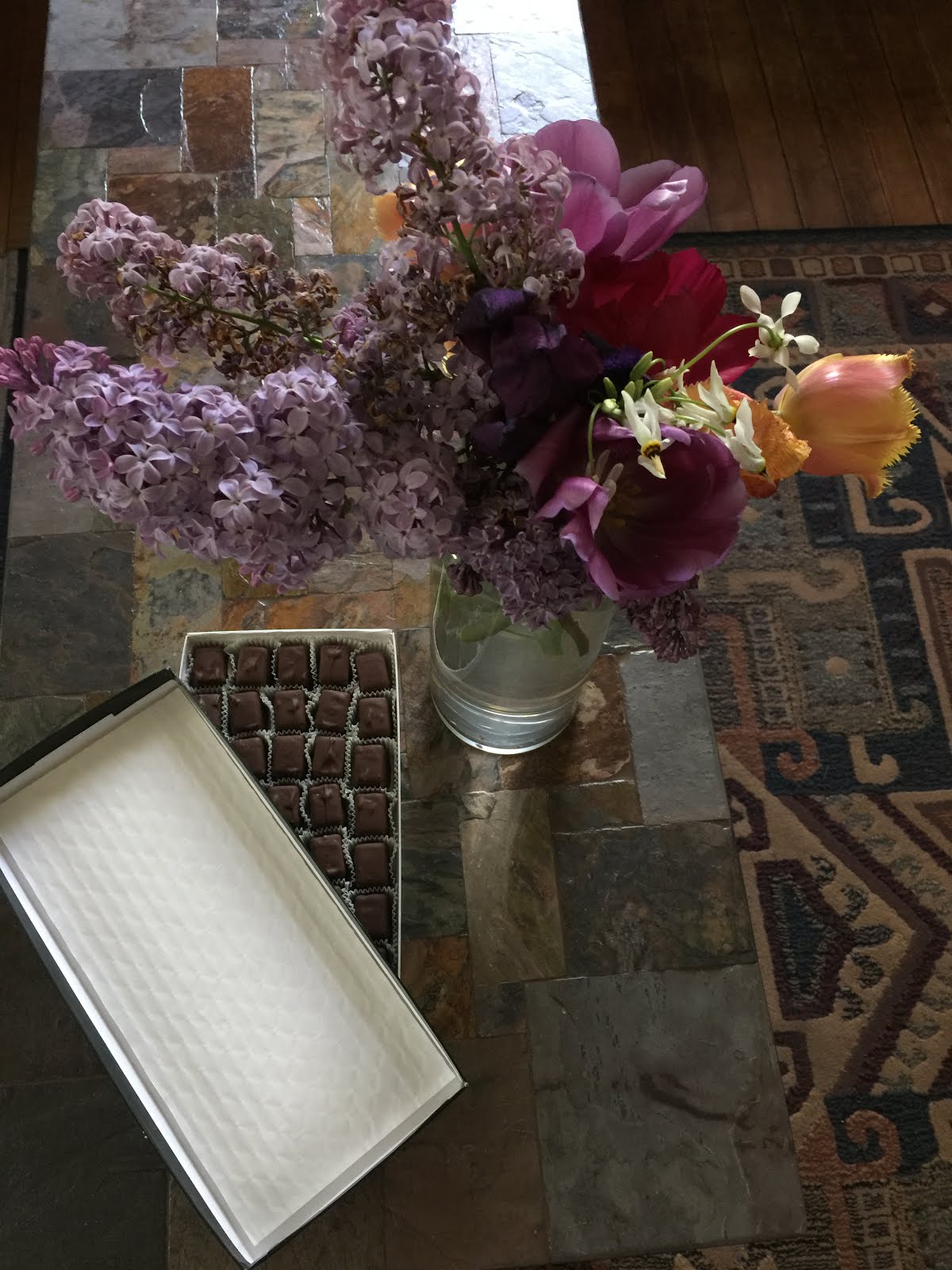
Picture, then inhale the scent, of your favorite flavor. Better even than lilacs, right? Chocolate offers poetry for the tastebuds, antidote for sadness, compensation for anxiety or stress. It’s also a reminder to everyone, including novelists, that enough is enough. 


Take details. Consider the many, many paragraphs of your novel that aren’t drama, action, or dialogue.  These fall into two general categories. 

Some narrative is immediately and directly integrated with the plot, thus creating or sustaining tension. Examples? Backstory, foreshadowing, some kinds of setting, or revelations of resources characters possess or lack. Description intrinsically linked to plot often zips along.

But a lot of the detail in novels has nothing to do with plot. Imagery and information often defeat tension. Still, novels would be mighty thin without description, symbolism, character nuance, and topics from art through zebras. 

Narrative, plot-oriented or otherwise, always affects pace, though the first  category far less than the second. That’s where chocolate comes in. First it fills your mouth with something besides your fingernails while you decide how much you need for clarity, reader satisfaction, and agent attraction. Chocolate soothes during the painful acceptance that you’re not a mindreader. Also, it warns that even something glorious can overwhelm, even nauseate, if over-indulged.  

You might consider all those add-ons that make fiction worth reading—and writing—as the sweet tang of chocolate: fantastic in moderation, but unappealing in smothering doses.

Tip: Too much, even of something quite wonderful, remains—too much.

Subtlety is key. According to Jerome Stern:
Serious writers, including comic writers, are interested in subtlety, in avoiding heavy-handed effects and obvious characterizations. They want to make readers pay close attention, and readers enjoy picking up on clues as subtle as a hesitation or a dropped glance.
Readers expect novels to order chaos, but not to remove every doubt. Readers want lots of chocolate, but not as the main course. These questions might help.
  • Do you leave space for reader imagination?
  • Do you overstate rather than imply?
  • Unsure whether readers “get it,” do you repeat once more, just to be sure?
  • Do you explain your metaphors?
  • Do your adverbs (“lazily,” crazily,” “dazedly”) “tell” what the dialogue already “shows”?
  • Do you ever overwhelm your plot with description or fact?
  • Do you write as if you have faith in reader ability to infer?
Thomas Mann observed that
Subtlety is the mark of confidence… A writer who is confident need not prove anything, need not try to grab attention with spates of stylism or hyperbole or melodrama… He will often leave things unsaid, may even employ a bit of confusion, and often allow you to come to your own conclusions.
In other words, enough chocolate to satisfy (which could be a lot!), but not to overwhelm.

Sunday, January 29, 2017

The Next Page—and the One After


What keeps readers turning pages, and why do you care? The first answer is complicated, the second simple. Without enthusiastic momentum, your reader—whether agent, publisher, or audience—is gone.

Happily, there’s more than one way to keep those fingers moving, because each reader turns pages for slightly different reasons. Here are some possibilities:

~ Suspense

This asset occurs frequently, because many readers and writers associate the novel with impassioned curiosity about what’s next. The supremacy of plot is somewhat genre dependent. Still, whatever your style or subject, don’t skimp on this expectation. Every genre needs some sort of tension on every page.

~ Characterization

Re-examine To Kill  Mockingbird, and its rather antiquated style might dismay you.  Why, then, do so many people list it as their most favorite ever? Few kids rival Scout’s gloriously naive sense of right and wrong. The same might be said of her extremely mature dad. Create characters one can’t forget, and readers will sigh when there are no more pages to turn.

~ Scenario

What do the Da Vinci Code and the Harry Potter series share in common? A wide range of people respond to mystery, underdogs, resourcefulness, and archetypes. Of course it rarely makes sense to replace the scenario that calls to you with a more marketable one. But it makes terrific sense to add heft, originality, danger. Can you make the Concept bigger? More enticing?

~ Emotions

Unless your characters experience them deeply, your readers won’t experience them at all. Yet belabor or “tell” about feelings, and readers still won’t respond. Emotions are concrete, dynamic responses to reality. Present them that way.

~ Secrets

Who doesn’t love them? But if we know too much or little, those whispers can irritate more than intrigue. It never hurts to map out how and when you dispense your novel’s secrets.

~ Humor 

Whether or not your novel is a comic one, exploit every opportunity for laughter, including the bleak irony of tragedy.

~ Poetry

Some novelists write so beautifully that we want more and more and more. At least occasionally, join them.

~ Intellectual curiosity

Those interested in classical music, RNA, or history can’t wait to see what Richard Powers will teach them on the next page of The Gold Bug Variations. What’s your audience curious about?

Whether drama, originality, voice, insight, or point of view, there’s more than one way to keep readers losing sleep and missing calls because they can’t put your book down.

Tip:  Know, internalize, and use your best tricks to keep the pages turning.

Sunday, June 26, 2016

Dive? Wade? Submerge?

Charge into your novel without some sort of outline, synopsis, or series of turning points, and you’ve plunged headfirst into three feet of water: you could spend a lot of time recovering from sad mistakes and broken parts. Not a pretty sight.

So what about edging in? Great, except you might get so comfortable at the shoreline that you never progress. Some academics don’t complete the dissertation because they continue researching. And researching. Some novelists can boast a nifty outline, sleek synopsis, or glorious first twenty pages. They never advance: too cold. Too scary.

So if you’re not supposed to plummet or inch, what might you do instead? I discovered some answers a few days ago, when I enjoyed the privilege of a brilliant, talented group of writers discussing how to get started. What are the pitfalls and panaceas? What’s the antidote for angst?

You might call this The Submersion Theory.

Submersion Theory.

Enter swiftly, but not haphazardly.

  1. Plan first.
If you just pour your heart out, it might sound like—your diary. George Sand wrote that way, and despite her many attributes, today she’d have a tough time finding an agent, a publisher, or readers. Contemporary fiction requires not only the deep psychological insights she offered, but a causal, well-paced plot . Few novelists accomplish that without a plan. A flexible plan, certainly. But a plan, nonetheless. Unless you’re among those fortunate few, design a strategy. You can always change it as you go. In fact, by all means change it as you go.

  1. Don’t procrastinate.
Once you design an approach, avoid posing endless unanswerable questions, like “Is writing a stupid hobby/proclivity/career move?” “Will I be good enough?” “How will I ever get an agent?” Most writers require some time, say a few months, to see if the scenario works and the characters come to life. Will the joy of creating this protagonist’s world transcend the stress of perfecting it? Grant yourself some time without self-destructive questions. As Mark Twain said on the subject not of worry, but conscience, “It takes up more room than all the rest of a person’s insides, and yet ain’t no good nohow.” Will hesitating, shaming, or agonizing really make you a better writer?

  1. Revise as you go.
Completing the first draft empowers you to perceive the shape of your story, develop what you omitted, and delete all those fantastic middle-of-the-night stream of conscious ideas that—aren’t all that great in the clear light of day. But if you save all your revising for the end, you’ll not endure a series of obstacles, but could wind up with flat characters, empty dialogue, a coincidental plot, and lots of ugly sentences.


Tip: Writing is like pace in fiction; proceed neither hastily nor hesitatingly.

Sunday, May 29, 2016

The “R” Factor, or Resilience for Readers and Writers

No one roots for the little engine that couldn’t or would recognize Beowulf if he muttered, “I’m doing the best I can.” The appeal of Katniss Everdeen isn’t difficulty choosing between two guys, or even her solid moral center.              

At least in others, not giving up turns us on. And this applies to both characters and those who create them.

The cast of Harper Lee’s To Kill a Mockingbird lives by this adage: “Real courage is when you know you're licked before you begin, but you begin anyway and see it through no matter what.”  

As George R.R. Martin, who authored Game of Thrones, puts it:

My own heroes are the dreamers, those men and women who tried to make the world a better place than when they found it, whether in small ways or great ones. Some succeeded, some failed, most had mixed results... but it is the effort that’s heroic, as I see it. Win or lose, I admire those who fight the good fight.

This dovetails nicely with Margaret Mitchell writing in Gone with the Wind:  “Hardships make or break people.”  What screenwriting guru Linda Seger calls “pressure points” reveal character. Those who haunt and inspire are at their best when adversity confronts them. What a winning combination: thicken the plot with dire circumstances, use those to drive arc, and wind up enriching tension, adding dimension, maintaining momentum, and highlighting theme.

Tip: Subject your characters to circumstances that demand perseverance.

Now. Is it fair to expect more of your characters than of yourself?

Perhaps one particular writing issue cramps your style. That could be character perseverance, causal plot, artless voice, sleek sentences, or whatever. Pretty much every writer must deal with something. Do you face yours with the determination you require in your protagonist?

Or maybe it’s the actual time and effort. Do you write often enough?  Seriously enough? Maybe you frequently rationalize, procrastinate, take the easy way out, give up too soon, or make everything but your writing a priority. Hmm. Does pressure elicit the best from you as it does from your protagonist?

Marketing. Say you’ve truly revised—deeply and thoroughly. You’ve solicited feedback and responded to suggestions. And you begin submitting. Five rejections later, you quit.  Among others, Louisa May Alcott, F. Scott Fitzgerald, Ernest Hemingway, James Joyce, Stephen King, Herman Melville, J, K. Rowling, Anita Shreve and Gertrude Stein did not. Any message there?

According to Maya Angelou, “You may encounter many defeats, but you must not be defeated. In fact, it may be necessary to encounter the defeats, so you can know who you are, what you can rise from, how you can still come out of it.”

Mark Twain says it in nine words:  “A few fly bites cannot stop a spirited horse.”

Tip: Remember The Little Engine That Could.


Sunday, January 17, 2016

Otherworldly

Look up “otherworldly,” and you’ll find lots on astral projection and interstellar travel. But good fiction is always “otherworldly,” even when it transports us to a world much like our own. As N.K. Jemisin put it in the N.Y.T. Book Review, “Beautiful writing just isn’t enough to save any story from overfamiliarity.”

Fiction transcends the familiar by altering the view. That might be an imaginary world, or simply the transformation of our own: deep penetration of one mind, the exquisite discovery of complexity in the apparently simple, or simplicity in the apparently complex.

What’s the source of this? The camouflaging and exposing of the novelist’s psyche:

Both candor and disguise are valid—even indispensable—ways of approaching the secret life in literature, and both can result in great art, though I believe disguise improves your chances, because the less you rely on autobiographical fact, the more your imagination is of necessity invoked. – David Jauss, “Autobiographobia: Writing and the Secret Life”

Fiction says the unsayable through characters enacting plot. Caroline Gordon is right that “A well-composed book is a magic carpet on which we are wafted to a world that we cannot enter in any other way.”

Only the merger of acute insight with fantastical invention can express those truths. You’ll need:

~ Groundwork.
Probe. Investigate. Observe yourself and others. Discard the rose-colored glasses. Gather the facts. It starts there.

~ Persona.
Create a narrator who represents the wisest, funniest, most objective and articulate version of yourself. You don’t get to comment in your novel. But without guidance, readers get muddled. To help them out, you don a mask. This transforms you into a narrator who escorts readers along the journey your novel captures.

~ Characterization.
The best characters are more credible than real people, even if they’re born on Saturnalia. These characters entice because they’re more driven, coherent, determined, and multi-dimensional than the people who inspired them.

~ Imagination.
It’s about compassion as much as originality. In The Power and the Glory, Graham Greene said, “Hate is a lack of imagination.” Only imagination lets us grasp how the other guy feels. That’s why J.K. Rowling called it “the power that enables us to empathize with humans whose experiences we have never shared.”

With or without aliens, wizards, or auras, find a way to think differently. So your readers can. Albert Einstein noted that “Logic will get you from A to B. Imagination will take you everywhere.” That’s as true for novelists as physicists. Logical coherence is indispensable to every world. Beyond that lies the otherworldly thrill of possibility.

Tip: “Otherworldly” should apply to language, plot, characterization, and setting in every novel.

Sunday, November 1, 2015

Do It with a Prop

This is a true story, and a prop started it all:

A Canadian couple who’ve been living together for several years decides to vacation in Venice. On the iconic Rialto Bridge, they pause before a jewelry shop. Its gold pieces tempt them inside. One of them admires a beautifully crafted plain gold band. She wants it. He agrees that it’s gorgeous and, what-the-heck—buys the other for himself.

Outside, with the gondoliers crooning corny songs as the red-velvet-lined gondolas sway on the mint-green waves, he turns to her. “So I guess this means we’re getting married?”

She nods. “Yes.”

They’re still married, and—I got to see their rings when this drama professor explained how he urges his students to use props. “What better way to both motivate and make motivation concrete?” Yes, indeed.

Tip: Props drive characters, promote causality, and transform abstract into concrete.

What makes props work?

~ Clarity.

Have to explain the prop? You haven’t found the right one yet.

~ Originality.

Instead of giving a gardener a trowel or a plumber a snake, choose something credible but unpredictable. Does the gardener make pottery for all those plants? Does the plumber play second base or collect old jazz albums?

~ Characterization.

Random props seem—random! For example, whether a guy wears his wedding band says something about him, just as what kind of engagement ring she likes says something about her. When props reveal and deepen character, you accomplish two things with one detail. Exquisite efficiency.

~ Symbolism.

The wedding ring works because it unexpectedly happened in a foreign country, albeit an exceedingly romantic one.  If Lucy spies a ring in Modern Bride and invites Herman to admire it, the effect is clichéd, heavy-handed, and not in the least romantic. Surprise us.

~ Causality.

According to the Canadian couple, without that window, they might never have married at all, and certainly not right then. The storefront caused action—the kind that drives fiction because one event (stopping before the window) causes the next (wedding bells). Serving coffee won’t necessarily enhance a scene. But staining the white carpet that he never wanted her to buy? That’s something else entirely.


Prop it up.

Sunday, August 23, 2015

Avoid Accidents!

Accidents can work wonders. People meet and fall in love, and perhaps if no asteroid hit the earth about 65 million years ago, no one could write or read this blog. But accidents and fiction are badly matched.

Plenty of accidents annoy or destroy. We leave the bread in the oven too long, saw lumber a quarter inch too short, delete favorite photos while making space in the Cloud, blurt painful things that never entirely disappear. Only the last one drives fiction. The others are entirely realistic and could deepen plot. Yet something’s missing.

Try this. “Prudence was minding her own business, when suddenly she decided to visit her mother’s grave, quit her job, end her marriage. Or she didn’t decide a thing, yet suddenly got struck by lightning, or a teen toying with his new handgun, or a car careening onto the sidewalk.”

Poor Prudence. Poor reader of a novel about Prudence. Suddenly? That enhances fiction about as much as “Meanwhile, back at the ranch…”

Fiction traces motive. Why suddenly end her marriage, and why’s she ruminating during the storm, especially when a random car veers onto the sidewalk? Why watch her ruminate at all?

Active choices have driven fiction for centuries. Even a novel as blatantly moralistic as Samuel Richardson’s “Pamela” (1740, subtitled “Virtue Rewarded “) examines motive. Squire B doesn’t make his move until his mom dies, and Pamela mistrusts her supposed benefactor. After probing human behavior and its result, the novel concludes both happily and morally.

Today’s readers might not call this book “licentious,” balk at class difference, or applaud Pamela’s obsession with chastity. But they might all agree that the book’s core is what the character must learn, just as Darcy and Elizabeth must unlearn pride and prejudice in the novel of that title. Some things never change.

How much can characters learn from random events, however tragic? Such events reveal heroism and weakness. Sometimes they reveal whom we really love or what really matters. Yet fiction’s most intriguing messages involve dilemmas, human choices, and their resolutions. So you might try the following:

~ Watch for the word “suddenly.” Is it an easy solution to a fictional issue you’d be better off solving?

~ Beware external events as plot pivots. Yes, war, tornadoes, and forest fires change lives. But can they contribute as much as revealing human psychology through—human psychology?

~ Trace the consequences of decisions. In real life ambivalence determines lots of outcomes; we simply refuse to decide—and something results because of that. But how powerful is inaction in fiction? How powerful are outcomes based on external forces rather than personal choices?

The greatest stories trace not battles, but character response to them; not famine, but character response to it, not poverty, but character response to it. Does your novel rely on unfortunate or tragic happenstance, or on the outcome characters earn or fail to? We look to fiction for what life doesn’t provide.


Tip: Accidents are part of life but serve minimal purpose in fiction.

Sunday, April 12, 2015

A Rose in a Cornfield Is a…

…weed. Misplaced, the most exquisite, evocative addition feels like…a mistake.

We’ve all experienced it:  “What a sentence! I love it! I can’t even believe I wrote it! Must’ve come directly from the Muse.” And yet, if you can’t find the right location for that fantastic sentence, you must let it go.

It helps to view your novel as a limited area of ground. You want to make the most of every inch, not let things that don’t belong there insidiously sneak in.

Don’t

…realize that readers need to know something and leave it wherever you happened to think of it.

…interrupt the action with distracting backstory or description. Note that distraction differs from
slowing down—teasing out suspense. The former is accidental, the latter deliberate.

…weigh down your story with detail that feels as relevant as Aunt Agatha’s best friend’s grandma’s traditional recipe for last-till-spring Christmas Fruitcake.

…add a brief passage about the Galapagos Islands because you did lots of research on it and long to share your discoveries about marine iguanas and Blue-Footed Boobies.

Do

…add “set up” just prior to “pay off,” so readers never wonder why they heard about this.

…limit details to those which enhance plot, deepen characterization, or foreshadow themes.

…make details “double-duty”: they advance plot while setting scene, or they add scenery while suggesting atmosphere, contribute irony to the plot, and so on.

…use transitions so readers can grasp the connections between details that might be linked only in the author’s mind.

…use stage business, or character gesture or behavior, to support the dialogue.

…remember that flowers set seeds. In fiction or soil, they grow wherever they happen to fall.

It’s easy to delete clumsy sentences, boring references, and paragraphs that go nowhere. Far harder is realizing that you’ve written something really good and have nowhere to put it. But whatever doesn’t add subtracts. Aren’t you willing to make hard sacrifices for your readers?


Tip: A great sentence or detail in the wrong place is a…rose in a cornfield.

Saturday, November 15, 2014

Plot and Its Delivery

Novels with great plots often succeed despite weak writing. Great plots generate movies and TV series, so cash flow follows. Sound great, right?  Yet unless your plot is extraordinary or your novel merely a draft for a screenplay, you might want to pay attention to the plot’s delivery. Lots of attention.

These elements can make adequate plots good and good plots great:

~Characterization.
One-dimensional characters never live, so their fate never matters much.

ü  Do you reveal your characters through action and dialogue, instead of through thoughts (potentially tedious) or commentary (potentially irritating)?
ü  Do your characters exhibit both consistency and complexity, as real people do?

~ Narrator/character balance.
Readers need the context only narrators can provide (summary of time, change of scene, exploration of complex motivation) in addition to the immediacy only characters present.

ü  Do you make use of both your narrator and characters?
ü  Do you put meaty, exciting events in scene using your characters?
ü  Does the narrator quickly and attractively deliver the logistics and background that are fun to write but deadly to read?

~ Supportive detail.
In Writing Fiction, Janet Burroway made two points about description: “The first is that the writer must deal in sense detail. The second is that these must be details ‘that matter.’” In other words, the best details involve one of the five senses, but that’s not enough. The detail must point toward what you what readers to see, hear, etc.

ü  Do your details ever distract from the story?
ü  Are all your details both concrete and significant?
ü  Do you amass catalogues of details because you haven’t found the one you need?

~ Texture.
Memorable novels offer something beyond familiar characters enacting a familiar plot, however competently that’s executed.

ü  Does your novel encourage readers to reach their own conclusions?
ü  Do you intertwine theme with plot?
ü  Does your story allude to concepts and conditions larger than itself?

~ Beauty.
Our world is an efficient and hasty one. Many readers don’t care about graceful sentences, and many writers feel that polishing sentences wastes time. Yet writers remain responsible for their writing.

ü  Do you want to write swiftly or beautifully?
ü  Wouldn’t you love readers exclaiming, “Wow—that’s gorgeous”?


Tip: if you polish both plot and delivery, you could earn both Pulitzer and film option.

Sunday, October 19, 2014

Beauty and the Best

America’s literary giants had plenty to say on the subject. Romantic Edgar Allan Poe asserted that “Beauty of whatever kind, in its supreme development, invariably excites the sensitive soul to tears.” Who could argue with that? Or with Ralph Waldo Emerson observing that “Love of beauty is taste. The creation of beauty is art.”

It’s no newsflash that interpretations of “beauty” or “art” vary widely. In fiction, though, beauty comes from characterization, from causality, from imagery and rhythmic syntax.

~ Characterization.

The more rapidly and insightfully you can develop a character, then the more exquisite the impact. In Ten Little Indians, Sherman Alexie does it in one sentence: “She wanted to be buried in a coffin filled with used paperbacks. ”

*** Are you gathering examples of characterization that strike you as particularly  concise and true? Are you seeking ways to accomplish this yourself?

~ Causality.

Jane Austen’s novels end happily because the characters mature enough to earn their happiness. Darcy overcomes pride and Elizabeth overcomes prejudice because neither can bear to lose the other.

***Are you noticing examples of causality? Does causality drive your own novel? Shouldn't it?

~ Imagery.

The best imagery works both literally and symbolically. It infuses the trivial with significance; it makes the ordinary extra-ordinary, but without calling attention to itself, like this example from Bernard Malamud’s The Natural:

Roy Hobbs pawed at the glass before thinking to prick a match with his thumbnail and hold the spurting flame to his cupped palm close to the lower berth window, but by then he had figured it was a tunnel they were passing through and was no longer surprised at the bright sight of himself holding a yellow light over his head, peering back in.

*** Do you catch yourself using three or four or five images? Does this suggest vague awareness that you haven’t found the right one?

~ Syntax.

Rhythm and emphasis can transform prose into poetry in prose. Like this: “People hide their truest nature. I understood that; I even applauded it. What sort of world would it be if people bled all over the sidewalks, if they wept under trees, smacked whomever they despised, kissed strangers, revealed themselves?” ― Alice Hoffman, The Ice Queen

*** Are you rationalizing sentences that don’t quite sound right? Are you aware that either craft or psychological obstacles often originate such sentences?


Tip: Savor beautiful writing. Collect it. Isn’t that the start to your own beautiful writing?

Sunday, September 7, 2014

The Little Writer That Could

Whether writing children’s books, fantasy, mystery, or anything else, novelists agree about one thing: Writing is hard. Gadzooks, look at all the things a writer must worry about: a hook to start and end every chapter, complex plot and deep characterization, transitions and point of view. Then you have to put it all together so it sounds as if you accomplished it effortlessly, rather than slaving over every word the way you probably did. Whether the feedback comes from a writing partner, critique group, or you yourself, the goal might feel like climbing Mt. Everest.

In “Mind the Gap” from David Jauss’s Words Overflown by Stars, Betsy Sholl, former Poet Laureate from Maine, observes that, “It only takes one little stammer, one little break in the flow, to become aware of how speech negotiates between our private consciousness and social engagement.”

Writing is hard because it communicates a unique individual vision to someone receiving it through words alone. That’s a challenge. So every time even a single word falters, it’s a metaphorical “stutter” that readers detect immediately. And if writers are any good, they, too, can hear it. Sadly, the more carefully you read, and, of course, write, the more sensitive your ears to even the faintest hint of stammer.

What’s the antidote? You could train yourself to be more careless? Read faster. Write faster. In general, worry lots less about the burden of graceful “social engagement.”

You don’t want that? Quality is your goal? If you’re certain, begin by curtailing those brutal, ugly, and self-defeating messages about what you can’t do. For many, developing patience about one’s goals and weaknesses is a tall mountain to conquer. Most folks with high standards are not only harder on themselves than they need to be, but harder than they should be for optimal productivity and creativity. “Can’t” is as dirty a word as any four-letter one out there.

Replace defeatism with a healthy dose of realistic self-analysis.  Aside from relinquishing “I can’t,” many writers consider identifying strengths quite daunting. Wit? Elegant sentences? Enthralling plot? Dynamite scenario? Write down your assets. All of them.

Now for the mountain. What’s up there? Whatever you identify as your own personal “stutter.” Inorganic plot? Stereotypical characters? Dreary syntax?  All but the weakest writers know well in advance what’s needed to conquer that mountain of difficulties. You even know what you must do to reach its peak. Your peak.

Beautiful writing emerges from a merger of talent and technique. You can sit before your computer until your butt’s sore, but unless you believe in both your talent and ability to hone it with technique, maybe fiction isn’t the mountain for you to master. The best training in the world won’t help if with every sentence you’re thinking “I’ll never make it to the top, never revise the way I want. I can’t.”


Tip: “I think I can” isn’t age-specific, and works as well for writers as for everyone else.

Sunday, January 19, 2014

The “I” of the Beholder

Since its inception, fiction has invited readers to see more deeply and differently. In Don Quixote, Cervantes gently asked what we mean by “romance,” while Henry Fielding’s Tom Jones questioned class and education.  Still, not all readers want their eyes opened, and even if they do, the same approach won’t work for every pair of eyes. No problem.

Tip: Not every novel will reach every novel reader.

This seems absurdly obvious. It’s not. We expect our loved ones to love the novels we love. If our friends dislike not just the great read we recently finished but our very own novel, it can feel considerably more depressing. That’s understandable. Also ever so slightly irrational. Here’s why.

Readers have diverse expectations.

 * Don't assume that all smart or sophisticated or educated people prefer “x” over “y.”
 * Do accept that  “Different strokes for different folks” isn’t just an idiom. It’s a reality.

Writers have diverse goals.

 * Don't presume that your novel will “work” for every single reader.
 * Do know your audience. Expand it without alienating your genuine audience.

Critique group members, like any group of readers, have diverse skills and tastes.

 * Don't quit your group or ignore the advice of those outside your “real” audience, or keep repeating, “I
    never read this genre, but your book seems to be…”
 * Do believe that every reader can be useful. Sift feedback rather than blindly obeying or wildly discarding.
    Critique objectively. Your group deserves that.

However diverse, all those different beholders share some things in common:

            All novel readers like suspense—motivation to keep turning pages.
            All novel readers like credible, intriguing characters.
            All novel readers like good writing.
            All novel readers like writers who consider audience and revise accordingly.
            All novel readers like the sensation that someone wrote this just for them.

Sunday, December 29, 2013

New, New, New, New, New

We’re starting a new year, which arrives with a flurry of resolutions, hopes, and dreams about a new start. Nu? What have you done to make your novel “new” lately? If you haven’t, perhaps you’d like to. Because our word for the long narrative comes from the Latin “novellus,” meaning, of course, “new.”

A novel that does nothing new is last year’s news. While it’s truer than ever that “there is nothing new under the sun,” it’s your job to make your novel feel new. These strategies might get you started.

~ Opening.
Link the setting and atmosphere to the dilemma, and any location or conflict becomes original.

~ Plot
Dig deep. As Don Maass frequently reminds, the first nine twists you generate will most likely lack the punch of the ones you brainstorm following that.

~ Character
Whore with a heart of gold? Quarterback who wants to make it big so he can save his family? Whores and quarterbacks—why not. Stereotypical ones? Uh, uh. Make one major change, be it status, dreams, occupation, even gender. Shake things up.

~ Syntax
Sentence structure is important and it’s not necessarily instinctive and English teachers aren’t the only ones who loathe run-ons and so you should get out of the rut. Vary. Change patterns. Transcend habits, even if that requires conscious, concerted effort.

~ Imagery
Roses are red. Skies are blue. Tears equal sad. Spring equals happy. Roses come in a rainbow of colors, as do skies. And character tears can make readers quite sad—for the wrong reason. Can’t find anything new for your scene? Turn it upside down. Probe its core. That’s where the imagery you need is hiding.

~ Climax.
If readers have expected a set scene for a couple hundred pages, don’t rob them of that pleasure. Still, satisfaction blends the predictable with the startling. One perfect detail will get the job done. Again, the secret is discarding the first dozen or so possibilities. The great ones come from thinking long and hard enough.

Tip: Resolve to find ways to make your novel “new” in this new year.


Have a happy one.

Sunday, December 8, 2013

A Wink at Alison Anderson’s "Darwin’s Wink"

Molly Giles, author of Iron Shoes and other fiction, described Anderson’s novel as “A love story, a war story, an ecological adventure, a biological poem, and a treatise on the fragility of life—Darwin’s Wink has it all..... Like the elusive, bejeweled mourning bird it celebrates, this book will waken its readers to unexpected wonders.”

Anderson’s novel is indeed exquisite, with wonderful tension in terms of danger as well as philosophy and morality. Yet not plot but idiosyncratic character and theme drive its momentum. That isn’t a recipe for everyone, and most writers are better off using quotation marks though not italics (especially inconsistent ones).

Still, this book offers numerous lessons, both Darwinian and otherwise, to every writer.

~ Omniscient point of view.
Anderson clearly but gracefully shifts perspective. This is difficult to execute, and she models both how to do it and why it’s worth the struggle.

~ Characterization.
Writers are often drawn to unappealing characters but then stuck with fiction that turns readers off. The blend of vulnerability and chutzpah that infuses all of Anderson’s characters is among the best strategies for counteracting the malaise of wounded characters.

~ Dialogue
With or without quotation marks, it’s tricky to have characters argue philosophy and sound both convincing and intriguing. This novel does that over and over.

~ Originality
Too many novels feel as you’ve already read something just like this. Here, though, the island is not only a place where you’ve never been, inhabited by people (and  birds) you’ve probably never even imagined, yet somehow evocative of the best fiction about islands, scientists, quests, dreams, and biology. Startling yet familiar. What could be better?

~ Plot as microcosm of theme.
These characters struggle with compassion versus necessity. How does being a human animal differ from being another animal? Should only the fittest survive?


Tip: Become a “fitter” writer by scrutinizing novels that epitomize your goals for your own.

Sunday, November 10, 2013

The Identity of Story

How much can you change a story and have it be its genuine self? Classics like “The Great Gatsby” endure numerous iterations, emphasizing certain variables and eliminating or altering others. This latest Leonardo DiCaprio version preserves many of the most famous lines and states the original themes so blatantly that F. Scott would drink himself to death even faster if he had to hear these lines.

But, aside from the disparities between film and fiction, is this still Fitzgerald’s story? Nick Carraway has become someone else—a fiction of screenwriter imagination. And because every narrator impacts story so powerfully, the transformation of Nick changes everything.

His most famous lines come near the novel’s opening: “Everyone suspects himself of at least one of the cardinal virtues, and this is mine: I am one of the few honest people that I have ever known.” Fitzgerald assures us that this is a reliable narrator, an antidote to “careless” Tom, Daisy, Jordan, and even Gatsby. Nick’s the human embodiment of the eyes that oversee a landscape of shame. In the film, though, Nick becomes voyeur rather than conscience, less an outsider than someone intent on sampling insider privileges.

The end of the film resurrects Fitzgerald’s vision, as a morose Nick muses that no matter how much we hurl ourselves forward, we remain doomed to endless retreat. This ending resurrects the original, suggesting what gives story identity.

It’s not character names. It’s not quite plot. No. Readers sense story identity through three avenues:

Point of view.
~ Your narrator is your reader’s window into your story. This controls what readers see, how remote that feels, and whether the view is pristine or occluded. Nick Carraway is a very particular window into the worlds of Gatsby and the Buchanans. Does your narrator succeed in emphasizing or concealing what you intend?

~ Voice.
Storytellers bewitch via authenticity combined with charm, humor, or majesty. But a genuine personality that’s long-winded, passive, and effete bewitches no one. Is your voice not just unique but one that readers want to hear long after the story ends?

~ Theme.
Plot is only a vehicle for delivering vision, and you can’t reduce any theme worth its weight in plot to a platitude. Do your themes embody a vision that’s yours alone?


Tip: Love and respect your story enough to protect its inherent integrity.